Free MCAT study note
Radioactive Decay and Half-Life Calculations for the MCAT
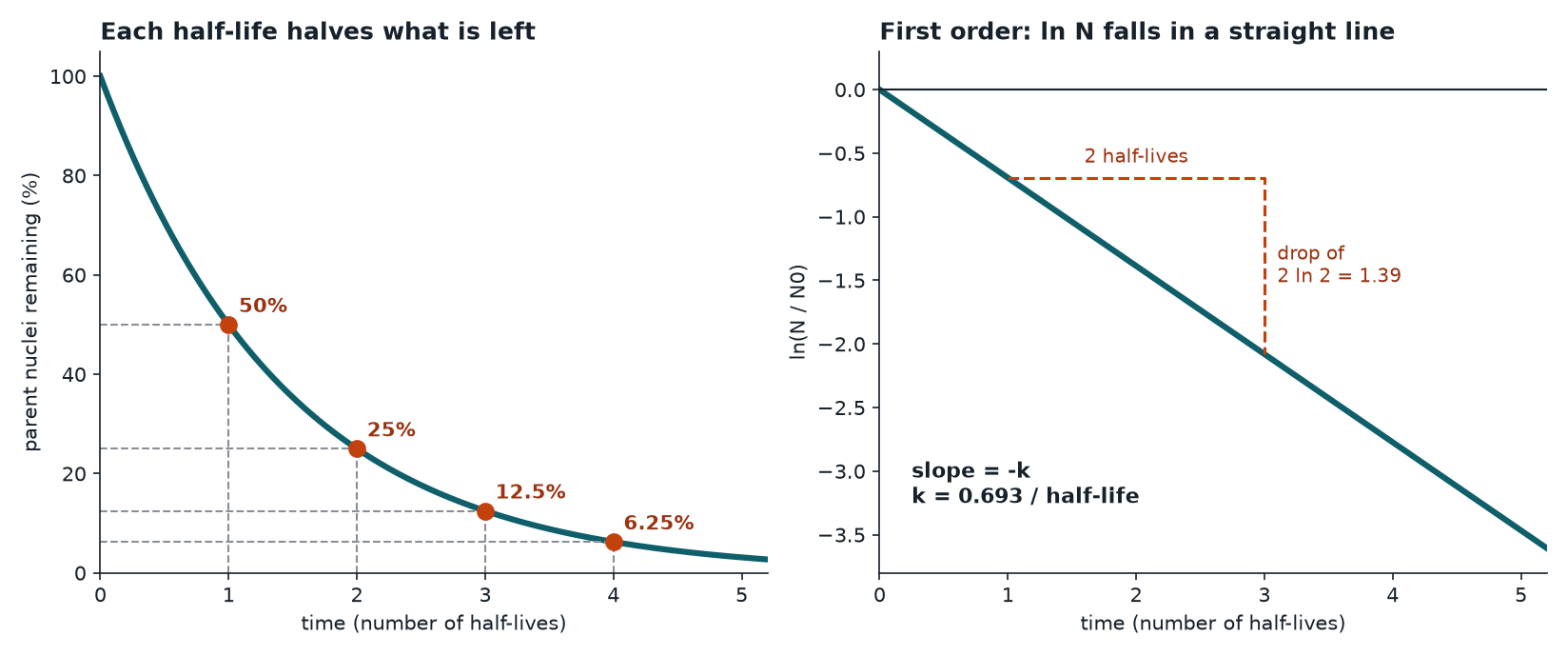
Radioactive decay is a first-order process: in each half-life, half of whatever parent nuclei remain will decay, no matter how many you start with. That single fact gives you the working formula N = N0(1/2)t/t1/2, and most half-life questions reduce to counting how many half-lives fit into the elapsed time. The other half of the topic is bookkeeping: every decay equation must conserve mass number (A) and atomic number (Z), and each decay mode changes them in a fixed way.
The decay modes and what they do to A and Z
Write a nuclide as AZX, where A is the number of protons plus neutrons and Z is the number of protons. A decay equation balances when the A values add up on both sides and the Z values add up on both sides.
| Mode | Particle emitted | Change in A | Change in Z | When it happens | Example |
|---|---|---|---|---|---|
| Alpha (α) | 42He nucleus | -4 | -2 | Heavy nuclei, mostly Z above 83 | 226Ra → 222Rn + α |
| Beta-minus (β-) | electron and antineutrino | 0 | +1 | Too many neutrons | 32P → 32S + β- |
| Beta-plus (β+, positron) | positron and neutrino | 0 | -1 | Too few neutrons | 18F → 18O + β+ |
| Electron capture | neutrino (an inner electron is absorbed) | 0 | -1 | Too few neutrons | 7Be + e- → 7Li |
| Gamma (γ) | high-energy photon | 0 | 0 | Excited nucleus relaxing | 99mTc → 99Tc + γ |
The logic behind the beta modes is worth owning rather than memorizing. In beta-minus decay a neutron inside the nucleus turns into a proton, so Z goes up by one while A stays the same. The emitted electron is created in that conversion; it does not come from the electron cloud. Beta-plus decay and electron capture both turn a proton into a neutron, so Z goes down by one. Since stable heavy nuclei need more neutrons than protons (up to about 1.5 neutrons per proton), a nucleus that is neutron-rich fixes itself with beta-minus decay, and one that is neutron-poor uses positron emission or electron capture.
To balance an unknown, write the two conservation sums separately. Suppose 21084Po emits an alpha particle. Mass: 210 = 4 + A, so A = 206. Charge: 84 = 2 + Z, so Z = 82, which is lead. The product is 20682Pb.
Penetration and ionization
The three classic emissions sort in opposite orders for penetration and ionization. Alpha particles are heavy and doubly charged, so they ionize strongly and are stopped by a sheet of paper or the outer layer of skin. Beta particles get through paper but are stopped by a few millimeters of aluminum. Gamma rays carry no charge and no mass, so they penetrate furthest and need thick lead or concrete for shielding. A useful consequence: an alpha emitter is relatively harmless outside the body but very damaging if swallowed or inhaled, because all of its energy is deposited in a small volume of tissue.
Why decay follows half-lives
Each unstable nucleus has the same fixed probability of decaying per unit time, set by the decay constant k. With N nuclei present, the number decaying per second is proportional to N:
rate = kN, which integrates to N = N0e-kt
Setting N = N0/2 and solving gives the half-life:
t1/2 = ln 2 / k = 0.693 / k
Because ln 2 is a constant, the half-life does not depend on how much material you have, on temperature, or on chemical form. A gram of iodine-131 and a kilogram of it both lose half their nuclei in about 8.0 days. Combining the two equations gives the version most problems use:
N / N0 = (1/2)n, where n = t / t1/2
Two related quantities show up in harder questions:
- Activity A = kN, the number of decays per second, measured in becquerels (1 Bq = 1 decay per second). Older problems use curies, 1 Ci = 3.7 × 10¹⁰ Bq. Since activity is proportional to N, it falls with the same half-life as the nuclei themselves.
- Mean lifetime τ = 1/k = t1/2 / 0.693, about 1.44 half-lives. It is the average time a nucleus survives before decaying.
A fraction table worth knowing cold
| Half-lives elapsed | Fraction remaining | Percent remaining | Percent decayed |
|---|---|---|---|
| 1 | 1/2 | 50% | 50% |
| 2 | 1/4 | 25% | 75% |
| 3 | 1/8 | 12.5% | 87.5% |
| 4 | 1/16 | 6.25% | 93.75% |
| 5 | 1/32 | about 3.1% | about 96.9% |
| 10 | 1/1024 | about 0.1% | about 99.9% |
The ten half-lives row is a handy anchor: 210 = 1024 is close to 1000, so after ten half-lives roughly one part in a thousand survives. Read questions carefully for "remaining" versus "decayed", since the two columns are easy to swap.
Worked examples
Example 1: whole numbers of half-lives
A hospital pharmacy measures 800 MBq of fluorine-18 (half-life about 110 minutes) at 8:00 a.m. What is the activity at 11:40 a.m.?
- Elapsed time: 3 hours 40 minutes = 220 minutes.
- Number of half-lives: n = 220 / 110 = 2.
- Activity: 800 × (1/2)2 = 800 / 4 = 200 MBq.
Example 2: a fractional number of half-lives
Technetium-99m has a half-life of about 6.0 hours. What fraction of a sample is left after 9.0 hours?
- n = 9.0 / 6.0 = 1.5.
- Fraction = (1/2)1.5 = 1 / (2 × √2) = 1 / 2.83, about 0.35, or 35%.
You can sanity-check this without a calculator: after one half-life 50% remains and after two 25% remains, so 1.5 half-lives must land between them. Because the curve is exponential, the answer sits a little below the midpoint of 37.5%.
Example 3: solving for time
How long until a sample of iodine-131 (half-life 8.0 days) falls to 10% of its starting amount?
- Set (1/2)n = 0.10, so 2n = 10.
- n = log 10 / log 2 = 1 / 0.301 = 3.32 half-lives.
- t = 3.32 × 8.0 days, about 27 days.
Bracket check: three half-lives leave 12.5% and four leave 6.25%, so 10% must fall between 24 and 32 days. On a multiple-choice question, the bracket alone usually picks the answer.
Example 4: radiocarbon dating
A wood sample has 12.5% of the carbon-14 found in living wood. Carbon-14 has a half-life of about 5730 years. Since 12.5% = (1/2)3, three half-lives have passed, and the age is 3 × 5730 = about 17,200 years. Living organisms keep exchanging carbon with the environment, so the clock starts at death, when uptake stops.
Example 5: comparing activities
Two samples contain the same number of nuclei: one of technetium-99m (half-life 6 hours) and one of iodine-131 (half-life 8.0 days, which is 192 hours). Which is more active, and by how much? Activity is kN and k = 0.693 / t1/2, so at equal N the activity ratio is the inverse of the half-life ratio: 192 / 6 = 32 times more active for Tc-99m. A short half-life means a hotter sample, not a weaker one.
Common traps
- Thinking a sample is gone after two half-lives. Two half-lives leave 25%, not zero. Decay approaches zero but never jumps to it.
- Subtracting half the original amount each time. Each half-life removes half of what is left, not half of the starting amount. The amounts go 100, 50, 25, 12.5, not 100, 50, 0.
- Expecting half-life to change with sample size, temperature or pressure. It does not. Nuclear decay is insensitive to ordinary chemical conditions.
- Getting the beta direction backward. Beta-minus raises Z (neutron becomes proton). Beta-plus and electron capture lower Z.
- Placing the beta electron in the electron cloud. It is made in the nucleus during the neutron-to-proton conversion.
- Forgetting that gamma changes nothing. A and Z are unchanged. Only the energy state of the nucleus drops.
- Linking "most penetrating" with "most ionizing". They are opposite ends: alpha ionizes most and penetrates least, gamma the reverse.
- Mixing time units. Convert the elapsed time and the half-life into the same unit before dividing.
One-minute recap
Balance every nuclear equation by conserving A and Z separately. Alpha: A drops 4, Z drops 2. Beta-minus: Z up 1. Beta-plus and electron capture: Z down 1. Gamma: no change. Decay is first order, so N = N0(1/2)t/t1/2 and t1/2 = 0.693/k. Count half-lives first, then halve that many times. For non-integer cases, bracket between whole half-lives or use logs. Activity A = kN falls with the same half-life, and at equal N a shorter half-life means higher activity.
Check yourself: 5-question mini-quiz
1. Thorium-232 (Z = 90) emits an alpha particle. What are the mass number and atomic number of the product?
A = 228 and Z = 88, which is radium-228. Alpha emission removes 4 from the mass number and 2 from the atomic number.
2. A nuclide with too many neutrons for stability most likely decays by which mode, and what happens to its atomic number?
Beta-minus decay. A neutron becomes a proton, so the atomic number rises by 1 while the mass number stays the same.
3. A sample of 640 mg of a nuclide with a 3-day half-life is stored for 12 days. How much of the original nuclide remains?
40 mg. Twelve days is four half-lives, and 640 divided by 2 four times (640 / 16) gives 40 mg.
4. What is the decay constant k of a nuclide whose half-life is 10 minutes?
About 0.069 per minute, since k = 0.693 divided by the half-life, and 0.693 / 10 min = 0.0693 per minute.
5. Doubling the amount of a radioactive sample does what to its half-life and to its activity?
The half-life stays the same, because it is a property of the nuclide. The activity doubles, because activity equals kN and N has doubled.
Keep studying
Email list
Get new packs and free notes
Packs are for sale now. Join the list and we email you when a new pack or free note goes up.
Free right now: the free sampler of study notes and practice questions.
You are on the list.
We will email you when a new pack or free note goes up. Meanwhile, start with the free sampler notes.