Free MCAT study note
Bottom-Up vs Top-Down Processing: Differences and Examples
Free MCAT sampler
Free sample: a 3-page MCAT cheat sheet (PDF), plus 6 short high-yield lessons by email
Enter your email and download a real page set from a paid pack: the 3-page Amino Acids, Proteins and Enzymes cheat sheet (PDF). Confirm your email and short MCAT lessons follow. Free, no card.
Prefer not to sign up? The sampler is open to everyone: free notes, practice sets and the study schedule generator.
Check your email
We sent a link to confirm your address. Nothing else is sent until you click it.
Download your free sample: 3-page Amino Acids, Proteins and Enzymes cheat sheet (PDF)
Meanwhile, start with the free notes.
Bottom-up processing builds a percept from the raw sensory signal, starting with small features and assembling them into a whole. Top-down processing runs the other way: your knowledge, expectations, goals and context shape how that signal is interpreted. Real perception uses both at once, so the useful question on a test is which direction is doing the deciding work in the scenario you are given.
The core difference in one table
| Feature | Bottom-up | Top-down |
|---|---|---|
| Starting point | The stimulus itself | The perceiver's knowledge |
| Also called | Data driven | Concept driven |
| Direction | Receptors toward higher brain areas | Higher brain areas back toward sensory processing |
| Works best when | The stimulus is new, clear and unfamiliar | The stimulus is noisy, incomplete or ambiguous |
| Typical error | Missing the big picture | Seeing what you expected instead of what is there |
| Key words in a stem | features, detectors, edges, intensity | expectation, context, prior experience, schema, set |
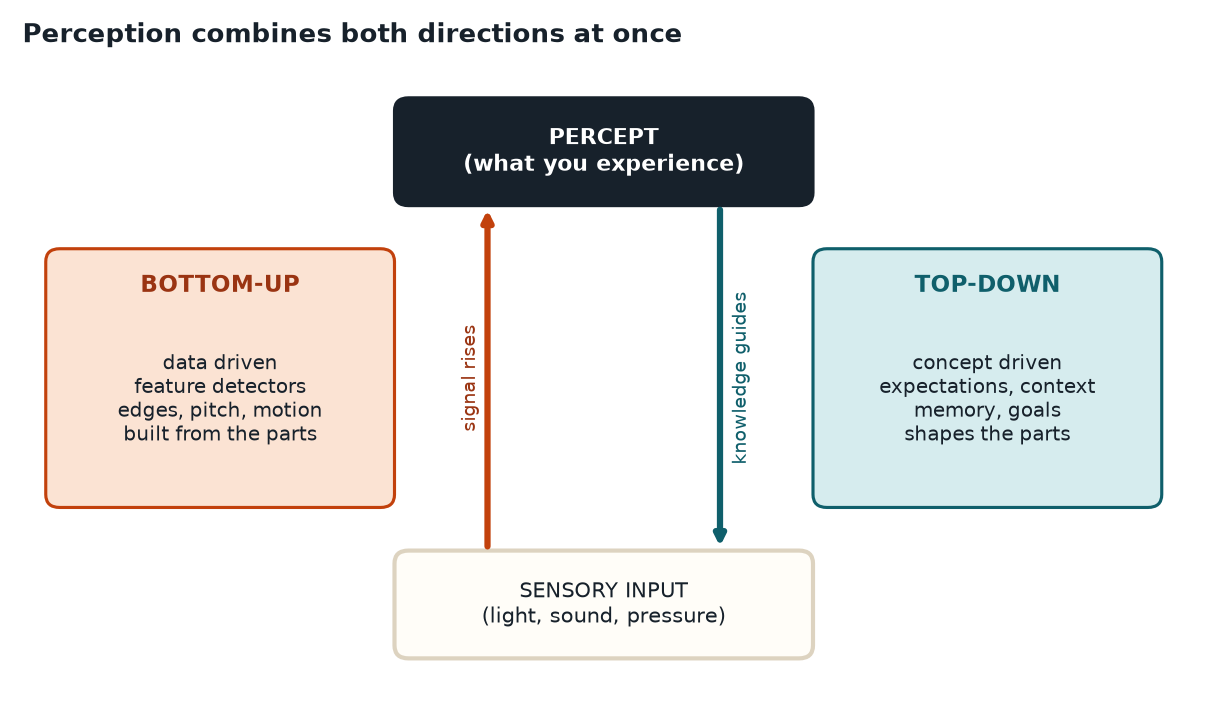
How bottom-up processing works
Bottom-up processing begins at the receptors. Photoreceptors, hair cells and mechanoreceptors convert energy into neural signals, and those signals climb through the thalamus (except smell) to primary sensory cortex. Along the way, neurons respond to simple features. In the visual system, Hubel and Wiesel showed that some cortical neurons fire most strongly to a line at a particular orientation, and others respond to movement in a particular direction. Those feature detectors are the textbook picture of bottom-up work: the brain extracts parts before it knows what the object is.
Bottom-up processing is what lets you handle something you have never seen before. If a stranger hands you an object with an unfamiliar shape, you can still describe its color, edges and size, because none of that depends on knowing what it is. The signal is enough.
A related idea is parallel processing. Color, form, motion and depth are analyzed at the same time by partly separate pathways, and the results are bound together later. Parallel processing is usually discussed with bottom-up processing because it describes how the incoming signal is split and analyzed, not how expectations act on it.
How top-down processing works
Top-down processing uses stored knowledge to guide interpretation. Higher areas send feedback to earlier sensory areas, and your expectations change what you notice and how you resolve uncertainty. Four ideas carry most of the weight:
- Schemas. Organized knowledge about how things usually go lets you fill in gaps.
- Context. The surrounding information changes how an ambiguous element is read.
- Perceptual set. A readiness to perceive something a certain way, created by recent experience, instructions or motivation.
- Goals and attention. What you are looking for biases what you detect.
The word superiority effect is a classic laboratory finding: a briefly flashed letter is identified more accurately when it appears inside a real word than when it appears alone. Knowledge of words improves perception of the letters that make them up, which is top-down influence at work.
Why the brain uses both
Neither direction is enough alone. Pure bottom-up processing would struggle with noisy, partial input, such as a voice in a crowded room. Pure top-down processing would let you see only what you already expected and miss anything new. In practice, the signal constrains the options and knowledge chooses among them. The less clear the signal, the more top-down processing matters.
Worked example: labeling scenarios
Read each scenario and ask which direction made the decisive contribution.
- A hiker sees a curved stick on a dim trail right after hearing a ranger warn about snakes, and jumps back. Top-down. The warning created a perceptual set, and an ambiguous shape was read as the expected threat.
- A newborn's visual neurons respond more to high-contrast edges than to plain gray fields. Bottom-up. Edge detection comes from the stimulus features, with no learned expectation needed.
- A proofreader skims a report she drafted and misses that "the the" appears in a sentence. Top-down. Knowing what the sentence should say lets her read the intended text instead of the printed one.
- A cook tastes an unfamiliar spice and describes it as bitter and slightly sour before knowing its name. Bottom-up. The description comes straight from taste receptor input.
- A listener on a crackling phone call hears a full sentence, even though several sounds were lost in static. Top-down, built on bottom-up input. The surviving sounds start the process, but knowledge of language fills in the gaps.
Scenario 5 is the realistic case. When an answer choice says one process "alone" explains a percept, be skeptical.
Connection to signal detection
Top-down factors also show up in signal detection theory. Expectations and motivation shift a person's response criterion, which changes how often they report a signal, even when the strength of the signal is the same. A radiologist told that a scan probably shows a tumor may report one more readily. That is a decision effect driven by knowledge, which links naturally to top-down processing.
Common traps
- Mixing up direction and level. Bottom-up does not mean "simple brain areas only." It means the stimulus drives processing. Top-down effects can reach early sensory areas through feedback.
- Calling every illusion top-down. Some illusions come from how early feature detectors respond to the signal, not from expectation. Read what the stem says causes the effect.
- Treating the two as opposites that cannot coexist. Almost every real percept combines them.
- Confusing top-down processing with attention alone. Attention is one top-down influence, but schemas, context and perceptual set count too.
- Linking feature detectors to top-down processing. Feature detectors are the standard bottom-up example.
One-minute recap
- Bottom-up: stimulus first, data driven, built from features, best for new or clear input.
- Top-down: knowledge first, concept driven, guided by schemas, context, perceptual set and goals.
- Ambiguous or degraded input pushes perception toward top-down filling in.
- Feature detectors and parallel processing go with bottom-up; expectation and the word superiority effect go with top-down.
- Real perception uses both, so watch for answer choices that say "only."
The 6A Sensation and Perception pack carries this topic into flashcards and practice questions on the visual pathway, perceptual organization and processing models, and the free sampler lets you try the format first.
Check yourself: 5-question mini-quiz
1. A student reads a smudged word as "doctor" because the sentence was about a hospital visit. Which process is mainly responsible?
Top-down processing, because the context of the sentence guided interpretation of an unclear stimulus.
2. Which finding is the standard example of bottom-up processing in vision?
Feature detectors, cortical neurons that respond to specific stimulus features such as a line at a particular orientation.
3. What is a perceptual set?
A readiness to perceive a stimulus in a particular way, created by expectations, recent experience or motivation, and it is a top-down influence.
4. When does top-down processing contribute the most to perception?
When the sensory input is ambiguous, incomplete or noisy, because knowledge must fill in what the signal does not supply.
5. What does the word superiority effect show?
Letters are identified more accurately inside real words than alone, showing that knowledge of words shapes perception of their parts.