Short answer
General structure of an alpha amino acid?
Short answer
General structure of an alpha amino acid?
Central alpha carbon bonded to an amino group, a carboxyl group, H, and a variable R group.
32 MCAT packs · featured: 1A Amino Acids, Proteins and Enzymes
StudyStore makes original, high-yield MCAT study packs. Each pack pairs a tight Anki deck with a printable cheat sheet, written from scratch and checked card by card.
Short answer
General structure of an alpha amino acid?
Short answer
General structure of an alpha amino acid?
Central alpha carbon bonded to an amino group, a carboxyl group, H, and a variable R group.
Cloze
Nonpolar, aliphatic side chains: [...], [...], [...], [...], [...], [...], [...]. They sit in the protein core.
Cloze
Nonpolar, aliphatic side chains: Gly, Ala, Val, Leu, Ile, Met, Pro. They sit in the protein core.
Hydrophobic effect buries them away from water.
Multiple choice
Side-chain charge of Asp at pH 7.4?
Multiple choice
Side-chain charge of Asp at pH 7.4?
B. Negative pKa about 3.9, so the carboxylate is deprotonated and negative.
True or false
Nearly all amino acids in human proteins are the L (S) enantiomer.
True or false
Nearly all amino acids in human proteins are the L (S) enantiomer.
True. Cysteine is the exception in CIP label only: it is L but R, because sulfur raises the CH2SH priority.
Short answer
What does the sign of delta G tell you about a reaction?
Short answer
What does the sign of delta G tell you about a reaction?
Negative delta G means exergonic and spontaneous as written. Positive means endergonic and needs energy input. Zero means equilibrium.
Cloze
Actual free energy change: delta G = delta G naught prime + [...]. At equilibrium, delta G equals [...] and Q equals [...].
Cloze
Actual free energy change: delta G = delta G naught prime + RT ln Q. At equilibrium, delta G equals zero and Q equals Keq.
Q is the reaction quotient, products over reactants at current concentrations.
Multiple choice
Which compound has a more negative hydrolysis delta G than ATP and rapidly regenerates ATP in resting muscle?
Multiple choice
Which compound has a more negative hydrolysis delta G than ATP and rapidly regenerates ATP in resting muscle?
D. Phosphocreatine Phosphocreatine (about -10.3 kcal/mol) donates its phosphate to ADP via creatine kinase. Glucose 6-phosphate and glycerol 3-phosphate are low-energy phosphate esters.
True or false
An enzyme makes a reaction more spontaneous by lowering its delta G.
True or false
An enzyme makes a reaction more spontaneous by lowering its delta G.
False. Enzymes lower activation energy only. delta G and Keq are unchanged, so the enzyme speeds both directions equally.
Short answer
Nucleoside versus nucleotide: what is the difference?
Short answer
Nucleoside versus nucleotide: what is the difference?
A nucleoside is sugar plus base. Adding one or more phosphate groups makes it a nucleotide.
Cloze
A nucleotide has a [...], a [...], and a [...].
Cloze
A nucleotide has a phosphate group, a pentose sugar, and a nitrogenous base.
Multiple choice
In a nucleotide, the nitrogenous base is attached to which sugar carbon?
Multiple choice
In a nucleotide, the nitrogenous base is attached to which sugar carbon?
B. The 1' carbon The base sits on C1' through an N-glycosidic bond. C5' carries the phosphate and C3' carries the OH that accepts the next nucleotide.
True or false
RNA is chemically less stable than DNA because of the 2' hydroxyl on ribose.
True or false
RNA is chemically less stable than DNA because of the 2' hydroxyl on ribose.
True. The 2' OH can attack the neighboring phosphodiester bond, so RNA hydrolyzes more easily, especially in base.
Short answer
How is an ester named from its two parts?
Short answer
How is an ester named from its two parts?
Alkyl group on oxygen first, then the acid name with -oate. Example: ethyl ethanoate (ethyl acetate).
Cloze
IUPAC suffixes: carboxylic acid [...], ester [...], amide [...], aldehyde [...].
Cloze
IUPAC suffixes: carboxylic acid -oic acid, ester -oate, amide -amide, aldehyde -al.
Ketone is -one, alcohol is -ol, amine is -amine, nitrile is -nitrile.
Multiple choice
Which compound is a secondary amine?
Multiple choice
Which compound is a secondary amine?
B. (CH₃)₂NH Secondary means two carbons on nitrogen. A is primary, C is tertiary, and D is an amide, not an amine.
True or false
An amide nitrogen is basic in the same way as an amine nitrogen.
True or false
An amide nitrogen is basic in the same way as an amine nitrogen.
False. The amide N lone pair delocalizes into the C=O, so amides are essentially neutral. Amines are basic.
Short answer
What do dendrites do?
Short answer
What do dendrites do?
Receive input from other neurons and carry graded potentials toward the soma.
Cloze
Direction of signal flow in a neuron: [...], then [...], then [...], then axon and [...].
Cloze
Direction of signal flow in a neuron: dendrites, then soma, then axon hillock, then axon and axon terminals.
Input at one end, output at the other.
Multiple choice
Multiple sclerosis most directly damages which cell type?
Multiple choice
Multiple sclerosis most directly damages which cell type?
A. Oligodendrocytes MS is autoimmune demyelination of the CNS, so the myelin-forming oligodendrocytes are the target. Schwann cells are hit in Guillain-Barre syndrome, which affects the PNS.
True or false
A single Schwann cell myelinates segments of many different axons.
True or false
A single Schwann cell myelinates segments of many different axons.
False. One Schwann cell wraps a single internode of one axon. Oligodendrocytes are the cells that wrap several axons.
Short answer
Trace the path of air from the nose to the alveoli.
Short answer
Trace the path of air from the nose to the alveoli.
Nasal cavity, pharynx, larynx, trachea, primary bronchi, smaller bronchi, bronchioles, alveolar ducts, alveoli.
Cloze
The conducting zone runs from the nose to the [...] and has no gas exchange; the respiratory zone begins with the [...].
Cloze
The conducting zone runs from the nose to the terminal bronchioles and has no gas exchange; the respiratory zone begins with the respiratory bronchioles.
The conducting zone is the anatomic dead space, about 150 mL.
Multiple choice
About what partial pressure of O2 (mmHg) is found in alveolar air at sea level?
Multiple choice
About what partial pressure of O2 (mmHg) is found in alveolar air at sea level?
B. 100 Alveolar PO2 is about 100 mmHg. Inspired dry air is about 160 mmHg, 760 is total atmospheric pressure, and 40 is typical venous PO2.
True or false
Goblet cell mucus and ciliary beating move trapped particles up toward the pharynx (the mucociliary escalator).
True or false
Goblet cell mucus and ciliary beating move trapped particles up toward the pharynx (the mucociliary escalator).
True. Cilia sweep the mucus layer upward; smoke paralyzes cilia and raises infection risk.
Short answer
State the three tenets of classical cell theory.
Short answer
State the three tenets of classical cell theory.
All living things are made of one or more cells; the cell is the basic unit of structure and function; all cells arise from pre-existing cells.
Cloze
Prokaryotic ribosomes are [...] (50S + 30S); eukaryotic cytosolic ribosomes are [...] (60S + 40S).
Cloze
Prokaryotic ribosomes are 70S (50S + 30S); eukaryotic cytosolic ribosomes are 80S (60S + 40S).
S is the Svedberg sedimentation unit, so subunit values do not add up to the whole.
Multiple choice
Which molecule crosses a lipid bilayer fastest by simple diffusion?
Multiple choice
Which molecule crosses a lipid bilayer fastest by simple diffusion?
C. O2 Small nonpolar gases pass freely. Glucose is large and polar and ions are charged, so both need proteins.
True or false
Viruses count as living cells because they carry out their own metabolism.
True or false
Viruses count as living cells because they carry out their own metabolism.
False. Viruses are acellular and have no metabolism of their own. They replicate only by hijacking a host cell, which is why they are the classic challenge to cell theory.
Short answer
Define a system and its surroundings in thermodynamics.
Short answer
Define a system and its surroundings in thermodynamics.
The system is the part of the universe under study. Everything else is the surroundings. System plus surroundings is the universe.
Cloze
A [...] depends only on the initial and final states. Examples: [...].
Cloze
A state function depends only on the initial and final states. Examples: U, H, S, G, T, P, V.
Path-independent. A change in a state function is just final minus initial.
Multiple choice
Which quantity is NOT a state function?
Multiple choice
Which quantity is NOT a state function?
D. Work done by the system Work depends on the path. U, S, and G depend only on the state.
True or false
Heat is a state function because energy is conserved.
True or false
Heat is a state function because energy is conserved.
False. Heat is a path function. Conservation links q and w to the state function U, but q alone depends on the route.
Short answer
Arrhenius definition of an acid and a base?
Short answer
Arrhenius definition of an acid and a base?
An acid raises [H+] in water. A base raises [OH-] in water.
Cloze
Bronsted-Lowry: an acid [...] a proton and a base [...] a proton. Lewis: an acid [...] an electron pair.
Cloze
Bronsted-Lowry: an acid donates a proton and a base accepts a proton. Lewis: an acid accepts an electron pair.
Multiple choice
Which species is the conjugate acid of HPO4 2-?
Multiple choice
Which species is the conjugate acid of HPO4 2-?
A. H2PO4- Add one proton to HPO4 2- to get H2PO4-. PO4 3- is its conjugate base. H3PO4 is two protons away.
True or false
Every Bronsted-Lowry acid is also an Arrhenius acid.
True or false
Every Bronsted-Lowry acid is also an Arrhenius acid.
False. Arrhenius acids must release H+ in water. Bronsted-Lowry also covers non-aqueous proton donors and acid-base reactions without water.
Short answer
Magnitude of the electrostatic force between two point charges?
Short answer
Magnitude of the electrostatic force between two point charges?
F = k q<sub>1</sub>q<sub>2</sub>/r<sup>2</sup>, with k = 9.0 x 10<sup>9</sup> N m<sup>2</sup>/C<sup>2</sup>.
Cloze
Coulomb's law: F = [...], where k = [...].
Cloze
Coulomb's law: F = k q<sub>1</sub>q<sub>2</sub>/r<sup>2</sup>, where k = 9.0 x 10<sup>9</sup> N m<sup>2</sup>/C<sup>2</sup>.
In terms of permittivity, k = 1/(4 pi e0).
Multiple choice
A +2.0 uC charge and a -3.0 uC charge are 0.30 m apart. The force between them is:
Multiple choice
A +2.0 uC charge and a -3.0 uC charge are 0.30 m apart. The force between them is:
B. 0.60 N, attractive F = (9.0 x 10<sup>9</sup>)(2.0 x 10<sup>-6</sup>)(3.0 x 10<sup>-6</sup>)/(0.30)<sup>2</sup> = 0.60 N. Opposite signs attract. Trap: using centimeters or dropping the micro prefix.
True or false
Net charge in an isolated system stays constant, even when charge moves between objects.
True or false
Net charge in an isolated system stays constant, even when charge moves between objects.
True. Charge is conserved. It can be transferred but not created or destroyed.
Short answer
Which SI base unit of mass is used in all derived units?
Short answer
Which SI base unit of mass is used in all derived units?
The kilogram (kg), not the gram. It is the only SI base unit that carries a prefix.
Cloze
Prefixes: kilo = [...], centi = [...], milli = [...], micro = [...].
Cloze
Prefixes: kilo = 10<sup>3</sup>, centi = 10<sup>-2</sup>, milli = 10<sup>-3</sup>, micro = 10<sup>-6</sup>.
Multiple choice
Which is an SI base unit?
Multiple choice
Which is an SI base unit?
B. Kilogram Newton, joule and pascal are derived units built from kg, m and s.
True or false
Dimensional analysis can prove an equation is correct.
True or false
Dimensional analysis can prove an equation is correct.
False. It only rules out equations with mismatched units; constants and dimensionless factors are invisible to it.
Short answer
Convert 1.00 g/cm³ to kg/m³.
Short answer
Convert 1.00 g/cm³ to kg/m³.
Multiply by 1000: 1.00 g/cm³ = 1000 kg/m³.
Cloze
Density is [...] per unit [...]: ρ = m/V, in units of [...].
Cloze
Density is mass per unit volume: ρ = m/V, in units of kg/m³.
Multiple choice
A 0.50 kg block occupies 2.0 × 10⁻⁴ m³. What is its density?
Multiple choice
A 0.50 kg block occupies 2.0 × 10⁻⁴ m³. What is its density?
B. 2500 kg/m³ ρ = m/V = 0.50 / 2.0×10⁻⁴ = 2500 kg/m³. The last option inverts the ratio.
True or false
The density of a pure substance depends on the size of the sample.
True or false
The density of a pure substance depends on the size of the sample.
False. Density is intensive. Mass and volume scale together, so their ratio does not change.
Short answer
How are wave speed, frequency, and wavelength related?
Short answer
How are wave speed, frequency, and wavelength related?
v = fλ. In a given medium the speed is fixed, so a higher frequency means a shorter wavelength.
Cloze
Frequency is measured in [...], which equals [...].
Cloze
Frequency is measured in hertz (Hz), which equals cycles per second (s<sup>-1</sup>).
Multiple choice
A wave has f = 50 Hz and λ = 4.0 m. What is its speed?
Multiple choice
A wave has f = 50 Hz and λ = 4.0 m. What is its speed?
A. 200 m/s v = fλ = 50 × 4.0 = 200 m/s. Dividing instead of multiplying gives 12.5, the common slip.
True or false
Increasing a wave's amplitude increases its speed in the medium.
True or false
Increasing a wave's amplitude increases its speed in the medium.
False. Speed depends on the medium. Amplitude changes the energy carried, not how fast the wave moves.
Short answer
What is a gene, at the molecular level?
Short answer
What is a gene, at the molecular level?
A stretch of DNA that encodes a functional product, usually a polypeptide or a functional RNA. It is the basic unit of heredity.
Cloze
A diploid cell carries [...] alleles for each autosomal gene, one from each [...].
Cloze
A diploid cell carries two alleles for each autosomal gene, one from each parent.
Multiple choice
Which genotype is heterozygous?
Multiple choice
Which genotype is heterozygous?
A. Dd Heterozygous means two different alleles at one locus. RR and tt are homozygous; XY describes sex chromosomes, not alleles of one gene.
True or false
The two alleles of a gene in one person sit at different loci on the homologs.
True or false
The two alleles of a gene in one person sit at different loci on the homologs.
False. Alleles of one gene occupy the same locus on the two homologs. Different genes occupy different loci.
Short answer
What happens in G2?
Short answer
What happens in G2?
The cell finishes growing, checks the replicated DNA, and makes proteins needed for mitosis such as tubulin and cyclin B.
Cloze
Order of the cell cycle: [...], then [...], then [...], then [...].
Cloze
Order of the cell cycle: G1, then S, then G2, then M.
G1, S and G2 together are interphase.
Multiple choice
Which cell type most likely stays in G0 for life?
Multiple choice
Which cell type most likely stays in G0 for life?
A. A mature neuron Mature neurons are terminally differentiated and do not divide. The other three populations keep cycling to replace lost cells.
True or false
DNA content doubles during mitosis.
True or false
DNA content doubles during mitosis.
False. DNA doubles in S phase. Mitosis only divides the already doubled DNA between two daughter cells.
Short answer
Where is the DNA of a bacterial cell located?
Short answer
Where is the DNA of a bacterial cell located?
In the nucleoid, an irregular region of the cytoplasm with no surrounding membrane.
Cloze
Prokaryotic ribosomes are [...], made of a [...] and a [...] subunit. Eukaryotic ribosomes are [...].
Cloze
Prokaryotic ribosomes are 70S, made of a 50S and a 30S subunit. Eukaryotic ribosomes are 80S.
Svedberg units are not additive: 50 + 30 does not equal 70 in S.
Multiple choice
Which feature is present in a bacterial cell?
Multiple choice
Which feature is present in a bacterial cell?
C. Ribosomes in the cytoplasm Bacteria have 70S ribosomes but no membrane-bound organelles. Their ETC sits in the plasma membrane.
True or false
Bacterial DNA is wrapped around histone proteins to form nucleosomes.
True or false
Bacterial DNA is wrapped around histone proteins to form nucleosomes.
False. Bacterial DNA is supercoiled and organized by nucleoid-associated proteins. Histones are an archaeal and eukaryotic feature.
Short answer
How do you calculate the formal charge of an atom in a Lewis structure?
Short answer
How do you calculate the formal charge of an atom in a Lewis structure?
Formal charge = valence electrons minus nonbonding electrons minus the number of bonds (half the bonding electrons).
Cloze
Formal charge = [...] minus [...] minus [...].
Cloze
Formal charge = valence electrons minus nonbonding electrons minus number of bonds.
Each lone pair counts as 2 nonbonding electrons; each bond counts as 1.
Multiple choice
Formal charge on nitrogen in NH4+ (four N-H bonds, no lone pair)?
Multiple choice
Formal charge on nitrogen in NH4+ (four N-H bonds, no lone pair)?
C. +1 5 - 0 - 4 = +1. N normally makes three bonds, so a fourth bond means a positive formal charge.
True or false
The formal charges in a Lewis structure sum to the overall charge of the molecule or ion.
True or false
The formal charges in a Lewis structure sum to the overall charge of the molecule or ion.
True. Zero for a neutral molecule, and equal to the ionic charge for an ion.
Short answer
Which particle count fixes the identity of an element?
Short answer
Which particle count fixes the identity of an element?
The number of protons, which is the atomic number Z.
Cloze
Mass number A = [...] + [...]. Atomic number Z = number of [...].
Cloze
Mass number A = protons + neutrons. Atomic number Z = number of protons.
In notation <sup>A</sup><sub>Z</sub>X, neutrons = A - Z.
Multiple choice
Which process releases energy on the binding energy curve?
Multiple choice
Which process releases energy on the binding energy curve?
B. Splitting U-235 into two medium nuclei Energy is released when products move toward Fe-56. Fission of very heavy nuclei and fusion of light nuclei both do this. Fe-56 changes absorb energy.
True or false
Isotopes of an element have very different chemical properties.
True or false
Isotopes of an element have very different chemical properties.
False. Chemistry is set by electrons, and isotopes have identical electron counts. Nuclear properties such as stability can differ greatly.
Short answer
What two properties must the solvent pair in a liquid-liquid extraction have?
Short answer
What two properties must the solvent pair in a liquid-liquid extraction have?
The two solvents must be immiscible (form two layers), and the target solute must be much more soluble in the extracting solvent than in the original one.
Cloze
Density rule: in a separatory funnel the [...] layer sits on the bottom, and water (d = [...] g/mL) is the usual reference.
Cloze
Density rule: in a separatory funnel the denser layer sits on the bottom, and water (d = 1.00 g/mL) is the usual reference.
If the layers are unclear, add a few drops of water and see which layer grows.
Multiple choice
Which solvent is a poor choice for extracting an aqueous solution because it mixes freely with water?
Multiple choice
Which solvent is a poor choice for extracting an aqueous solution because it mixes freely with water?
C. Ethanol Ethanol is miscible with water, so no second layer forms. Ether, dichloromethane and hexane are all immiscible with water.
True or false
Polar organic compounds dissolve best in the nonpolar solvent layer of an extraction.
True or false
Polar organic compounds dissolve best in the nonpolar solvent layer of an extraction.
False. Like dissolves like: polar compounds favor water, nonpolar compounds favor the organic layer.
Short answer
Describe Broadbent's filter model of attention.
Short answer
Describe Broadbent's filter model of attention.
Early selection: a filter passes one channel by physical features (such as location or pitch) and blocks the rest before meaning is analyzed.
Cloze
Piaget's four stages in order: [...], [...], [...], [...].
Cloze
Piaget's four stages in order: sensorimotor, preoperational, concrete operational, formal operational.
Ages: 0 to 2, 2 to 7, 7 to 11, 11 and up.
Multiple choice
A driver tunes out the radio to concentrate on merging into fast traffic. Which process is she using?
Multiple choice
A driver tunes out the radio to concentrate on merging into fast traffic. Which process is she using?
A. Selective attention Focusing on one input while filtering the rest is selective attention. Divided attention would mean following the radio and the road at once.
True or false
The cocktail party effect shows that unattended speech receives no processing for meaning.
True or false
The cocktail party effect shows that unattended speech receives no processing for meaning.
False. Hearing your own name in an ignored conversation shows some unattended input is analyzed for meaning, which Treisman's attenuation model explains.
Short answer
Why can a neuron not fire again during the absolute refractory period?
Short answer
Why can a neuron not fire again during the absolute refractory period?
Voltage-gated Na+ channels are inactivated, so no stimulus strength can start a new spike.
Cloze
Resting membrane potential is about [...], kept by the Na+/K+ ATPase moving [...] Na+ out and [...] K+ in.
Cloze
Resting membrane potential is about -70 mV, kept by the Na+/K+ ATPase moving 3 Na+ out and 2 K+ in.
Plus K+ leak channels.
Multiple choice
Which drug action explains why SSRIs raise mood?
Multiple choice
Which drug action explains why SSRIs raise mood?
A. Blocking serotonin reuptake SSRIs inhibit the serotonin transporter, so serotonin stays in the synapse longer.
True or false
A stronger stimulus makes a bigger action potential.
True or false
A stronger stimulus makes a bigger action potential.
False. Spikes are all-or-none. A stronger stimulus raises the firing rate or recruits more neurons.
Short answer
Define absolute threshold.
Short answer
Define absolute threshold.
The minimum stimulus intensity detected 50 percent of the time. Weaker stimuli are subthreshold.
Cloze
Weber's law: [...] / [...] = [...], where k is the [...].
Cloze
Weber's law: delta I / I = k, where k is the Weber fraction.
A small k means high sensitivity.
Multiple choice
Weight has k = 0.02. How much extra weight is needed to notice a change from a 250 g baseline?
Multiple choice
Weight has k = 0.02. How much extra weight is needed to notice a change from a 250 g baseline?
A. 5 g JND = k x I = 0.02 x 250 = 5 g. A 2 g change is below threshold at this baseline.
True or false
A smaller Weber fraction means finer discrimination.
True or false
A smaller Weber fraction means finer discrimination.
True. A small k means a small proportional change is detectable, so the system is more sensitive.
Short answer
What is attribution theory?
Short answer
What is attribution theory?
It describes how people explain the causes of behavior, their own and others', as due to the person or to the situation.
Cloze
Kelley's covariation model uses three kinds of information: [...], [...], and [...].
Cloze
Kelley's covariation model uses three kinds of information: consensus, distinctiveness, and consistency.
Kelley (1967) treated people as intuitive scientists who compare behavior across people, targets, and time.
Multiple choice
A student fails and thinks, 'I am simply not smart enough.' Which pattern is this?
Multiple choice
A student fails and thinks, 'I am simply not smart enough.' Which pattern is this?
B. Internal and stable Ability is internal and stable. This pattern after failure predicts low expectancy of future success.
True or false
Under attribution theory, people's causal explanations are always accurate because they weigh the evidence logically.
True or false
Under attribution theory, people's causal explanations are always accurate because they weigh the evidence logically.
False. Attributions are often biased shortcuts (for example the fundamental attribution error and self-serving bias).
Short answer
Triplett's 1898 children's study used what task to show social effects on performance?
Short answer
Triplett's 1898 children's study used what task to show social effects on performance?
Winding fishing reels; children wound faster when working beside another child than when alone.
Cloze
Zajonc's drive theory: the presence of others raises [...], which enhances the [...].
Cloze
Zajonc's drive theory: the presence of others raises arousal, which enhances the dominant response.
The dominant response is correct on easy tasks and wrong on hard ones.
Multiple choice
Which phenomenon describes a performance advantage from the presence of coactors working on the same task?
Multiple choice
Which phenomenon describes a performance advantage from the presence of coactors working on the same task?
A. Coaction effect Coaction is social facilitation with others doing the same task, as in Triplett's cyclists. The other options describe group effects on helping, belief, or restraint.
True or false
Cottrell argued that mere presence alone, even of a blindfolded audience, is enough to produce social facilitation.
True or false
Cottrell argued that mere presence alone, even of a blindfolded audience, is enough to produce social facilitation.
False. Cottrell found that a blindfolded audience did not produce the effect, so he attributed arousal to evaluation apprehension. Zajonc is the mere presence theorist.
Short answer
Why are habituation and sensitization called nonassociative learning?
Short answer
Why are habituation and sensitization called nonassociative learning?
The organism changes its response to a single stimulus without linking two stimuli or linking a response to a consequence.
Cloze
A decline in response to a repeated, harmless stimulus is called [...], the simplest form of nonassociative learning.
Cloze
A decline in response to a repeated, harmless stimulus is called habituation, the simplest form of nonassociative learning.
A decline in response to a repeated, harmless stimulus. It is the simplest form of nonassociative learning.
Multiple choice
After a loud crash, a person jumps at a quiet footstep. This is
Multiple choice
After a loud crash, a person jumps at a quiet footstep. This is
D. sensitization A strong stimulus raised responsiveness to a different, weak stimulus. No stimulus pairing or consequence is involved, so it is nonassociative sensitization.
True or false
Habituation requires pairing the repeated stimulus with a second stimulus.
True or false
Habituation requires pairing the repeated stimulus with a second stimulus.
False. Habituation involves a single repeated stimulus. Pairing two stimuli is classical conditioning.
Short answer
Core claim of functionalism about society?
Short answer
Core claim of functionalism about society?
Society is a system of interdependent parts, each serving a function that promotes stability and social order.
Cloze
Parsons' AGIL: [...], [...], [...], and [...] (pattern maintenance).
Cloze
Parsons' AGIL: Adaptation, Goal attainment, Integration, and Latency (pattern maintenance).
Every social system must solve these four problems to survive.
Multiple choice
A town builds a stadium for sports. Residents also meet neighbors and feel civic pride. The pride is a:
Multiple choice
A town builds a stadium for sports. Residents also meet neighbors and feel civic pride. The pride is a:
A. Latent function The pride was not the stated goal, and it benefits society, so it is a latent function.
True or false
Functionalists see inequality as always harmful and unnecessary.
True or false
Functionalists see inequality as always harmful and unnecessary.
False. Davis and Moore argued stratification can be functional by rewarding the most important, hard-to-fill roles.
Short answer
What is spatial inequality?
Short answer
What is spatial inequality?
The unequal distribution of resources, opportunities, and hazards across places, so where a person lives shapes life chances.
Cloze
Massey and Denton's segregation dimensions: [...], [...], [...], [...], and clustering.
Cloze
Massey and Denton's segregation dimensions: evenness, exposure, concentration, centralization, and clustering.
Hypersegregation means high scores on most of them at once.
Multiple choice
A city's neighborhoods are racially separated with no current law requiring it. This is best called:
Multiple choice
A city's neighborhoods are racially separated with no current law requiring it. This is best called:
A. De facto segregation No law mandates it, so it is de facto. De jure requires a legal rule.
True or false
Redlining was a purely private practice with no government involvement.
True or false
Redlining was a purely private practice with no government involvement.
False. Federal agencies and lenders used government-linked risk maps, so policy helped create the pattern.
Short answer
Define self-concept.
Short answer
Define self-concept.
The set of beliefs, knowledge, and feelings a person holds about who they are, built from experience and feedback.
Cloze
A self-schema makes a person [...] to notice and [...] at remembering information that fits it, and [...] to information that does not.
Cloze
A self-schema makes a person quick to notice and better at remembering information that fits it, and resistant to information that does not.
Markus studied people schematic for independence or dependence.
Multiple choice
Which term describes the self as the object that is known, in James's framework?
Multiple choice
Which term describes the self as the object that is known, in James's framework?
B. The 'me' James's 'me' is the empirical self (material, social, spiritual). The 'I' is the knowing, acting subject.
True or false
Self-concept is fixed by early childhood and does not change afterward.
True or false
Self-concept is fixed by early childhood and does not change afterward.
False. Self-concept keeps developing; roles, feedback, and life events revise it, although a strong self-schema resists change.
Short answer
Define an achieved status.
Short answer
Define an achieved status.
A status gained through personal effort, choice, or merit, such as surgeon, graduate, or parent.
Cloze
[...]: A position a person occupies in society, which comes with expected behaviors and a place in a social hierarchy.
Cloze
Social status: A position a person occupies in society, which comes with expected behaviors and a place in a social hierarchy.
Multiple choice
Which is the best example of an ascribed status?
Multiple choice
Which is the best example of an ascribed status?
A. Being the child of a royal family Family of origin is assigned, not chosen. The other three are earned through effort or selection.
True or false
A master status must always be ascribed.
True or false
A master status must always be ascribed.
False. A master status can be achieved (physician, convicted felon) or ascribed (race, disability). What defines it is dominance over other statuses, not how it was gained.
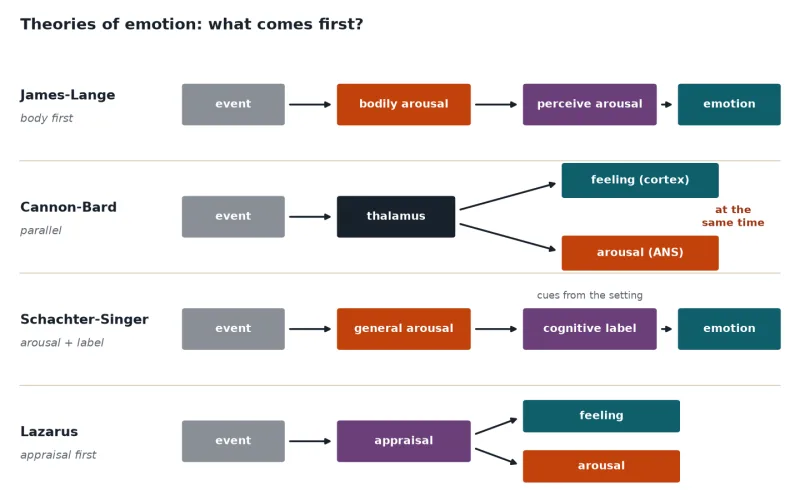
Short answer
What are the three components of an emotion?
Short answer
What are the three components of an emotion?
Physiological (bodily arousal), cognitive (appraisal and subjective feeling), and behavioral (expression and action).
Cloze
Emotion has [...], [...], and [...] components.
Cloze
Emotion has physiological, cognitive, and behavioral components.
Remember that each can be measured separately, and they do not always agree.
Multiple choice
Which dimension separates 'calm' from 'excited' when both are pleasant?
Multiple choice
Which dimension separates 'calm' from 'excited' when both are pleasant?
A. Arousal Both are positive in valence. They differ in how activated the body and mind are.
True or false
The three components of emotion always rise and fall together.
True or false
The three components of emotion always rise and fall together.
False. They can dissociate, for example when someone feels afraid but hides it.
Short answer
Cohort effect: what does it explain?
Short answer
Cohort effect: what does it explain?
Differences between groups that come from the era in which they grew up, not from their current age.
Cloze
An [...] is a group of people born in the same period who share the historical events of their formative years.
Cloze
An age cohort is a group of people born in the same period who share the historical events of their formative years.
Multiple choice
A man in a nursing unit is promoted faster than his female coworkers. Which term applies?
Multiple choice
A man in a nursing unit is promoted faster than his female coworkers. Which term applies?
B. Glass escalator Men in female-dominated fields often rise quickly, called the glass escalator. The glass ceiling blocks advancement instead.
True or false
Disengagement theory holds that older adults should stay as active as possible.
True or false
Disengagement theory holds that older adults should stay as active as possible.
False. That is activity theory. Disengagement says withdrawal from roles is mutual and normal in later life.
Short answer
What is a passage map?
Short answer
What is a passage map?
A short margin note per paragraph (3 to 6 words) that records what the paragraph does, not what it says in detail.
Cloze
A passage map has four parts: the [...], a [...], the author's [...], and the [...].
Cloze
A passage map has four parts: the topic, a purpose note per paragraph, the author's tone, and the main idea.
These are the four things a finished map records.
Multiple choice
An author writes that a policy is "well meant but poorly built." The tone is best described as:
Multiple choice
An author writes that a policy is "well meant but poorly built." The tone is best described as:
B. Qualified disapproval The phrase gives credit (well meant) and criticism (poorly built). Scathing overshoots; laudatory ignores the criticism; indifferent ignores the opinion words.
True or false
A passage map should record every statistic so you can answer detail questions.
True or false
A passage map should record every statistic so you can answer detail questions.
False. The map records purpose. Details are looked up in the text when a question asks, which is faster than recording them.
Real cards from our decks, one per MCAT section, picked at random. Click to flip.
Fig. 1 · Enzyme kinetics, drawn as you scroll
01
v = Vmax[S] / (Km + [S]). Velocity climbs, then flattens as every enzyme is saturated.
02
Km is the [S] at half of Vmax. Low Km means tight binding.
03
Binds free enzyme at the active site. Apparent Km rises; Vmax unchanged. More substrate wins.
04
Binds E and ES equally. Vmax falls; Km unchanged.
05
Binds only ES. Km and Vmax both fall, so Lineweaver-Burk lines run parallel.
Bio/Biochem · MCAT 1A packFree note: inhibition types comparedFree practice questions
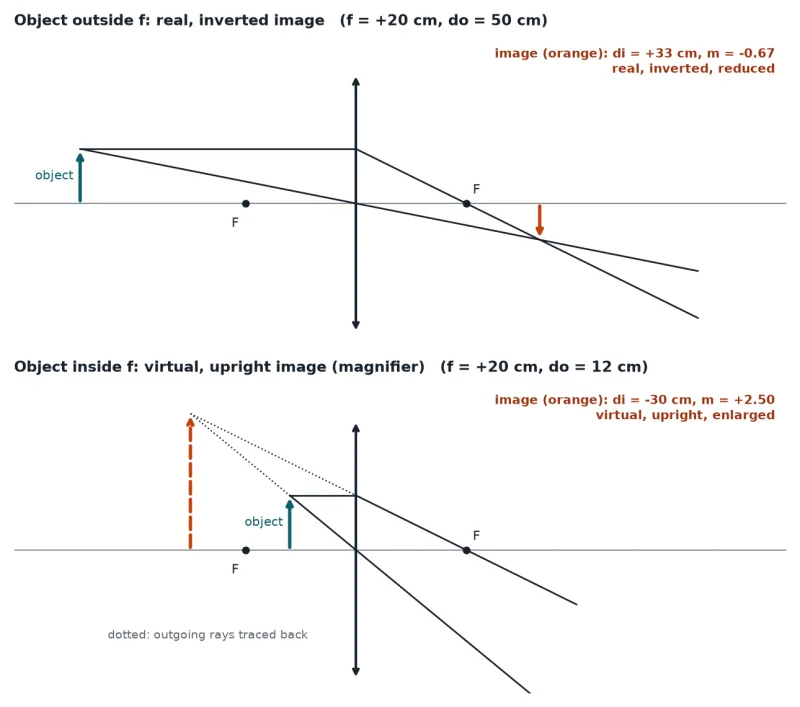
Fig. 1 · Thin lens, drawn as you scroll
01
Object at 3f from a converging lens. 1/f = 1/do + 1/di puts the image at 1.5f: real, inverted and smaller.
02
do = 2f gives di = 2f and m = -di/do = -1. Real, inverted, same size.
03
The image runs out past 2F and grows: at do = 1.5f, di = 3f and m = -2. This is how a projector works.
04
1/di = 1/f - 1/f = 0. Refracted rays leave parallel, so no image forms.
05
Rays diverge; trace them back. At do = 0.5f, di = -f and m = +2: virtual, upright, enlarged. A magnifying glass.
Chem/Phys · MCAT 4D packFree note: thin lens sign conventionsFree practice questions
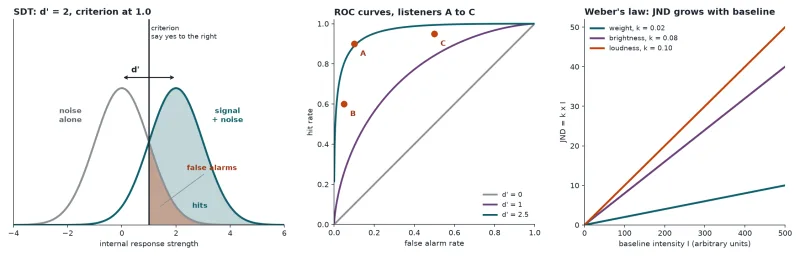
Fig. 1 · Signal detection, drawn as you scroll
01
Every trial gives an internal response. Noise alone makes one distribution; signal plus noise makes a second one, shifted right.
02
d' is the distance between the two means in standard deviations. A stronger signal or a sharper observer pulls the curves apart.
03
The observer says yes past the criterion. Signal area past the line is the hit rate; noise area past it is the false-alarm rate.
04
Slide the criterion left: more hits, but more false alarms too. d' does not change.
05
Slide it right: fewer false alarms, more misses. Bias moves the line; only sensitivity moves the curves.
Psych/Soc · MCAT 6A packFree note: signal detection and Weber's lawFree practice questions
Fig. 1 · A CARS passage map, drawn as you scroll
01
Find the sentence the rest of the passage defends. Here: a mature canopy is infrastructure.
02
"But" is a pivot. It turns against the view in the first sentence, and the sentence after it carries the author's real point.
03
Evaluative words reveal judgment. "Shortsighted" says the author is critical, not neutral.
04
What supports the claim? Cooler shaded blocks and slower stormwater. Note it in a few words; the details stay in the passage.
05
Say the main idea in one sentence, with the author's attitude in it. Then answer the questions from the map.
CARS · CARS strategy packFree note: how to approach a CARS passageFree practice passage
Many city budgets still treat street trees as decoration, the first line item cut when money is tight. But a mature canopy is infrastructure, as essential to a city as its pipes and pavement. Shaded blocks stay measurably cooler on summer afternoons, and leaves and roots slow the stormwater that would otherwise overwhelm the drains. Cutting that canopy to save money is shortsighted: a young tree needs decades to replace the shade an old one gave.
Try it · 3 sample questions
3 real practice questions from across the catalog, word for word, picked at random from 153. A new set every visit. Pick an answer to see the explanation that ships with it.
Q1What is the approximate net charge of the tripeptide Lys-Asp-Gly at pH 7.4?
B. At pH 7.4 the free N-terminal amine is +1, the Lys side chain is +1, the Asp side chain is -1, and the free C-terminal carboxylate is -1, for a net charge of 0. Answering +1 or +2 forgets one or both negative groups, and -1 forgets the N-terminus. From the 1A pack: Amino Acids, Proteins and Enzymes
Q2Why does the peptide bond not rotate freely?
D. Delocalization of the nitrogen lone pair onto oxygen makes the amide plane rigid. A hydrogen bond, ionic bond, or disulfide would be a different type of interaction and would not describe the amide linkage. From the 1A pack: Amino Acids, Proteins and Enzymes
Q3An enzyme transfers an amino group from one molecule to another. Which EC class?
A. Group transfer defines EC 2 (transferases), as with aminotransferases. Ligases join molecules using ATP, lyases cleave without water or redox, and isomerases rearrange one molecule. From the 1A pack: Amino Acids, Proteins and Enzymes
Q4Aspirin inhibits cyclooxygenase by:
A. Aspirin transfers an acetyl group to a Ser, permanently blocking the enzyme. Reversible competitors (such as ibuprofen) behave differently, and aspirin does not target ES or heme. From the 1A pack: Amino Acids, Proteins and Enzymes
Q5Iron in the heme of hemoglobin must be in which state to bind oxygen?
A. Fe2+ (ferrous) binds O2 reversibly. Fe3+ (methemoglobin) does not bind oxygen, and Fe0 and Fe4+ are not the physiological states in heme. From the 1A pack: Amino Acids, Proteins and Enzymes
Q6A reaction has a standard delta G of +4.2 kcal/mol. It is coupled to ATP hydrolysis (-7.3 kcal/mol). What is the delta G of the coupled reaction?
D. Coupled reactions add: +4.2 + (-7.3) = -3.1 kcal/mol, so it is favorable. +11.5 and -11.5 result from adding magnitudes with the wrong signs, and +3.1 flips the sign of the sum. From the 1D pack: Metabolism and Bioenergetics
Q7How many high-energy phosphate bonds are consumed to make one glucose from two pyruvate?
C. Two pyruvate carboxylase steps use 2 ATP, two PEPCK steps use 2 GTP, and two phosphoglycerate kinase steps in reverse use 2 ATP, totaling 6 (4 ATP and 2 GTP). From the 1D pack: Metabolism and Bioenergetics
Q8A child has hepatomegaly and fasting hypoglycemia, and glycogen has a normal structure. Which enzyme is the most likely defect?
D. G6Pase deficiency (von Gierke) causes hypoglycemia with massive hepatomegaly and normal glycogen structure. Branching enzyme gives abnormal structure, Pompe affects lysosomes and the heart, and muscle phosphorylase affects muscle only. From the 1D pack: Metabolism and Bioenergetics
Q9A patient on a statin has a markedly lower hepatic cholesterol synthesis rate. Which compensatory change is expected?
C. Low sterol activates SREBP-2 processing, which raises LDL receptor expression and clears more LDL from plasma, lowering LDL. Reductase transcription rises, not falls, and SREBP-2 processing increases rather than decreases. From the 1D pack: Metabolism and Bioenergetics
Q10A person has fasted for 5 days. Compared with day 1, which change is expected?
D. By day 5 ketones are the major brain fuel, and nitrogen loss is reduced. Liver glycogen is gone, ketones are high, and insulin is low. From the 1D pack: Metabolism and Bioenergetics
Q11Two DNA duplexes of equal length have melting temperatures of 85 C and 72 C. The higher Tm sample most likely has
D. G-C pairs have three hydrogen bonds and stack more strongly, so more G-C raises Tm. More A-T lowers Tm, nicks do not raise stability, and lower salt would lower Tm by increasing phosphate repulsion. From the 1B pack: DNA, Genetic Information and Gene Expression
Q12Why do human chromosomes need many replication origins?
C. At about 50 nt/s, a single origin could not copy hundreds of millions of base pairs in S phase, so many origins fire in parallel. Human chromosomes are linear, and origins fire once per cycle because of licensing. From the 1B pack: DNA, Genetic Information and Gene Expression
Q13The template strand of a gene is 3'-TACGTTAA-5'. What is the mRNA?
C. RNA pairs antiparallel with the template and uses U for T: 5'-AUGCAAUU-3'. The first option copies the template, the second contains T, and the last is written in the wrong direction. From the 1B pack: DNA, Genetic Information and Gene Expression
Q14A mutant activator keeps its DNA-binding domain but lacks its activation domain. In the cell it would most likely
D. The DNA-binding domain still docks on the enhancer, but without the activation domain it cannot recruit coactivators. It can even compete with the normal activator. From the 1B pack: DNA, Genetic Information and Gene Expression
Q15In a Sanger reaction the ddNTP to dNTP ratio is increased tenfold. The fragments will
C. A higher ddNTP fraction terminates chains earlier, producing shorter fragments. Lower ddNTP would give longer fragments, and termination still occurs at multiple positions. From the 1B pack: DNA, Genetic Information and Gene Expression
Q16What is the IUPAC name of CH3CH2CONH2?
D. The three-carbon chain with a C(=O)NH2 group is a propanamide. Propanamine would be an amine, propanoic acid has COOH, and N-methylethanamide has a CH3 on nitrogen and only two chain carbons. From the 5D pack: Biologically Relevant Molecules and Organic Reactivity
Q17Cyclohexanone reacts with a secondary amine (pyrrolidine) and acid catalyst, with water removal. The major product is:
A. A secondary amine has only one N-H, so after forming the carbinolamine it cannot make a neutral C=N and instead loses an alpha proton to give an enamine. Imines come from primary amines, an amide needs an acyl derivative, and an acetal needs two alcohols. From the 5D pack: Biologically Relevant Molecules and Organic Reactivity
Q18Which species is aromatic?
D. Pyrrole is planar and cyclic with six pi electrons, four from the double bonds and two from nitrogen. Cyclobutadiene (4 pi electrons) and the cyclopentadienyl cation (4) are antiaromatic, and cyclooctatetraene is nonplanar and nonaromatic. From the 5D pack: Biologically Relevant Molecules and Organic Reactivity
Q19A diterpene contains how many isoprene units?
D. Terpenes are named by units: mono 2, sesqui 3, di 4, tri 6. A diterpene has 20 carbons. Two is a monoterpene, three a sesquiterpene, and six a triterpene such as squalene. From the 5D pack: Biologically Relevant Molecules and Organic Reactivity
Q20Which compound has the highest boiling point at similar molar mass?
A. A carboxylic acid forms strong hydrogen-bonded dimers, giving a higher boiling point than even the alcohol. The aldehyde and ester cannot donate hydrogen bonds, so they boil lower. From the 5D pack: Biologically Relevant Molecules and Organic Reactivity
Q21A patient develops ascending muscle weakness two weeks after a viral infection, and nerve conduction is slowed. Which cells are the most likely target?
A. Guillain-Barre syndrome attacks PNS myelin, made by Schwann cells, which slows conduction. Oligodendrocytes make CNS myelin and are involved in multiple sclerosis. Astrocytes and microglia do not form myelin. From the 3A pack: Nervous and Endocrine Systems
Q22Which structure belongs to the PNS?
D. The dorsal root ganglion lies outside the cord and holds sensory neuron cell bodies. The dorsal horn and central canal are inside the cord, and the corpus callosum is in the brain. From the 3A pack: Nervous and Endocrine Systems
Q23A subject notices the difference between 100 g and 102 g. Using Weber's law, what difference is needed to notice a change from 400 g?
C. The JND is a constant fraction (2 percent) of the baseline, so 400 g needs 8 g. A constant 2 g would ignore the baseline, and 4 g or 40 g use the wrong fraction. From the 3A pack: Nervous and Endocrine Systems
Q24After a head injury, a patient loses the sense of smell. What is the most likely damage?
B. Fine olfactory axons cross the cribriform plate to the olfactory bulb and can be sheared by trauma. The optic chiasm, vagus and cochlear nerve serve other senses. From the 3A pack: Nervous and Endocrine Systems
Q25A patient stops long-term prednisone abruptly and becomes weak and hypotensive. Why?
A. Chronic glucocorticoid suppresses CRH and ACTH, leading to adrenal atrophy and cortisol deficiency when the drug stops. Aldosterone is usually preserved because it depends on RAAS, and the medulla does not make cortisol. From the 3A pack: Nervous and Endocrine Systems
Q26A patient with pulmonary fibrosis has a normal alveolar PO2 but a low arterial PO2. What is the best explanation?
B. Fick's law says diffusion falls as membrane thickness increases, so equilibration is incomplete and PaO2 lags behind alveolar PO2. Surfactant loss lowers compliance, dead space affects ventilation not diffusion, and carbonic anhydrase handles CO2. From the 3B pack: Organ Systems
Q27A patient on warfarin has a prolonged INR. Which clotting factor is NOT reduced?
B. Warfarin blocks vitamin K recycling, lowering the vitamin K-dependent factors II, VII, IX and X. Factor VIII is not vitamin K dependent. From the 3B pack: Organ Systems
Q28A mouse lacks functional MHC II. Which defect is expected?
D. MHC II presents peptide to CD4 helper cells, which drive B cell class switching and memory. CD8 cells use MHC I, NK cells and complement do not require MHC II. From the 3B pack: Organ Systems
Q29Which structure senses distal tubular NaCl and regulates the afferent arteriole?
D. The macula densa signals tubuloglomerular feedback and renin release. Podocytes form the filtration slits, vasa recta preserve the gradient, and principal cells respond to ADH and aldosterone. From the 3B pack: Organ Systems
Q30An organophosphate pesticide inhibits acetylcholinesterase. What happens at the neuromuscular junction?
A. Persistent ACh keeps the end plate depolarized and desensitized. Botulinum toxin blocks release, curare blocks receptors, and dantrolene-type drugs affect SR Ca2+ release. From the 3B pack: Organ Systems
Q31A new antibiotic selectively blocks the 30S ribosomal subunit. Why is it relatively safe for human cells?
C. Prokaryotes have 70S ribosomes (50S + 30S). Eukaryotic cytosolic ribosomes are 80S (60S + 40S) and are not blocked. Human cells do have ribosomes, they are in the cytoplasm and on the ER, and drug entry is not the selectivity mechanism. From the 2A pack: Cells, Membranes and Tissues
Q32A membrane permeable only to water separates 0.2 M glucose on the left from 0.1 M NaCl on the right. What happens?
A. NaCl gives two particles, so 0.1 M NaCl is 0.2 Osm, equal to 0.2 M glucose (0.2 Osm). With equal osmolarity there is no net water flow, so neither direction is favored. Solutes cannot cross, so NaCl does not move either. From the 2A pack: Cells, Membranes and Tissues
Q33A mutation prevents the LDL receptor from binding clathrin adaptors. LDL will
C. The receptor still recognizes LDL, but clathrin-coated pit formation needs the adaptor interaction, so uptake fails. Binding is intact, so it does bind, internalization is not normal, and extracellular degradation is not a feature. From the 2A pack: Cells, Membranes and Tissues
Q34Severe diarrhea occurs from a mutation that makes intestinal tight junctions leaky. The most likely explanation is
A. Tight junctions limit paracellular movement. When leaky, solutes and water pass between cells. Gap junctions do not seal the epithelium, hemidesmosomes anchor to the matrix, and endocytosis is unrelated. From the 2A pack: Cells, Membranes and Tissues
Q35Which finding best supports the bacterial origin of mitochondria?
C. A circular genome and binary-fission-like division resemble bacteria. ATP production and widespread distribution do not show origin. Nuclear-encoded mitochondrial proteins reflect gene transfer, not an origin as such. From the 2A pack: Cells, Membranes and Tissues
Q36Which of the following is a state function?
B. Entropy depends only on the state. Heat and work depend on the path, and the path itself is not a property of a state. The other choices fail because each describes a quantity tied to how the change happened. From the 5E pack: Chemical Thermodynamics and Kinetics
Q37During the boiling of water at 1 atm, the heat supplied
B. At the plateau, energy overcomes intermolecular attractions. T and average KE stay constant, and vapor pressure equals the external pressure. From the 5E pack: Chemical Thermodynamics and Kinetics
Q38For a spontaneous process, ΔS(system) = -40 J/K. This is possible if
B. The second law needs ΔS(universe) > 0. A system can lose entropy when the surroundings gain more. In an isolated system ΔS(sys) itself must be positive. From the 5E pack: Chemical Thermodynamics and Kinetics
Q39A reaction has k = 4.0 x 10^-3 s^-1. The overall order is
B. A unit of s^-1 is the signature of first order, because rate (M/s) = k[A] requires k in s^-1. Zero order would need M/s, second order M^-1 s^-1, and third order M^-2 s^-1. From the 5E pack: Chemical Thermodynamics and Kinetics
Q40Which conditions favor the thermodynamic product?
B. Equilibration lets material funnel to the most stable product. Low T, short time, and irreversibility lock in the kinetic product. From the 5E pack: Chemical Thermodynamics and Kinetics
Q41Which species acts as a Lewis acid in AlCl3 + Cl- -> AlCl4-?
A. AlCl3 has an empty orbital on aluminum and accepts an electron pair from Cl-. Chloride is the donor (Lewis base). AlCl4- is the product. The Lewis definition does not require protons, so the last option is wrong. From the 5A pack: Water, Solutions, Acids and Bases
Q42At pH 7.4, which phosphate species pair dominates (pKa2 = 7.20)?
A. pH is 0.2 above pKa2, so the ratio is 10^0.2 = 1.6 HPO4 2- per H2PO4-. H3PO4 is minor above pH 4. PO4 3- appears only near pKa3 (12.35), and both species are present, not just H2PO4-. From the 5A pack: Water, Solutions, Acids and Bases
Q43A weak base B (0.10 M, pKb 4.75) is half-neutralized by HCl. The pH is:
A. At half-equivalence [B] = [BH+], so pH = pKa of BH+ = 14 - 4.75 = 9.25. The value 4.75 is the pKb (a pOH here), 7.00 is for a strong acid and strong base, and 5.28 is the pH at full equivalence. From the 5A pack: Water, Solutions, Acids and Bases
Q44Ksp of PbI2 is 7.1 x 10^-9. Its molar solubility is closest to:
A. Ksp = 4s^3, so s = (7.1e-9/4)^(1/3) = 1.2e-3 M. 8.4e-5 uses s^2 (the AB formula), 7.1e-9 is the Ksp itself, and 1.8e-3 uses the wrong power. From the 5A pack: Water, Solutions, Acids and Bases
Q45The osmotic pressure of 0.050 M CaCl2 at 300 K (R = 0.0821 L atm/mol K, i = 3) is closest to:
A. pi = iMRT = 3 x 0.050 x 0.0821 x 300 = 3.7 atm. 1.2 atm omits i, 0.12 atm uses the wrong power of ten, and 11 atm is three times too large. From the 5A pack: Water, Solutions, Acids and Bases
Q46Two point charges exert a force F on each other. One charge is tripled and the separation is halved. The new force is:
D. Tripling one charge multiplies F by 3, and halving r multiplies it by 4 (inverse square), so F becomes 12F. 6F misses the square on r, 3F/4 puts the factor on the wrong side, and 3F/2 mixes the two errors. From the 4C pack: Electrostatics, Circuits, Magnetism and Electrochemistry
Q47A battery with an open-circuit voltage of 9.0 V delivers 2.0 A with a terminal voltage of 6.0 V. What is its internal resistance?
B. The lost voltage is 9.0 - 6.0 = 3.0 V across r, so r = 3.0 V/2.0 A = 1.5 ohm. 3.0 ohm is the external resistance (6.0/2.0), 4.5 ohm would be 9.0/2.0 (the total resistance), and 0.67 ohm inverts the ratio. From the 4C pack: Electrostatics, Circuits, Magnetism and Electrochemistry
Q48A 2.0 uF capacitor discharges through a 1.0 megohm resistor. About how long does it take for the voltage to fall to half its starting value?
D. tau = RC = 2.0 s and the half-time is tau ln 2 = 0.693 x 2.0 = 1.4 s. 2.0 s is the time to reach 37 percent, 0.50 s inverts tau, and 4.0 s is 2 tau (13.5 percent left). From the 4C pack: Electrostatics, Circuits, Magnetism and Electrochemistry
Q49A 0.20 m wire carrying 4.0 A is perpendicular to a 0.30 T field. The magnetic force on the wire is:
B. F = BIL sin 90 = (0.30)(4.0)(0.20) = 0.24 N. 0.060 N is B x L x 1 (forgetting the current), 0.015 N is a misplaced decimal, and 3.8 N inverts the arithmetic. From the 4C pack: Electrostatics, Circuits, Magnetism and Electrochemistry
Q50Three metals have standard reduction potentials A+/A = +0.50 V, B2+/B = -0.20 V, and C+/C = -1.00 V. Which pair gives a galvanic cell with the largest E0 cell?
D. The largest E0 comes from the most negative anode and the most positive cathode: 0.50 - (-1.00) = 1.50 V with C as the anode and A as the cathode. The 0.70 V and 0.80 V pairs are galvanic but smaller, and the last pair reverses the roles, giving a negative (nonspontaneous) value. From the 4C pack: Electrostatics, Circuits, Magnetism and Electrochemistry
Q51A sprinter runs at 36 km/h. Her speed in m/s is
A. Divide km/h by 3.6: 36/3.6 = 10 m/s. Multiplying by 3.6 gives 129.6, the common inversion error. The speed is not unchanged in m/s, and 1.0 is off by a factor of ten. From the 4A pack: Motion, Forces, Work and Energy
Q52A 0.40 kg ball on a 0.80 m string moves in a horizontal circle at 4.0 m/s. The tension is
A. T = m v^2/r = 0.40 x 16/0.80 = 8.0 N. The value 2.0 N forgets to square the speed (mv/r), 6.4 N forgets to divide by the radius, and 20 N is the acceleration v^2/r with the mass left out. From the 4A pack: Motion, Forces, Work and Energy
Q53A spring with k = 300 N/m is stretched 0.20 m from equilibrium. The stored energy is
D. U = 1/2 k x^2 = 0.5 x 300 x 0.04 = 6.0 J. The value 12 J forgets the 1/2, 60 J mistakes the spring force kx = 60 N for an energy, and 3.0 J halves again. From the 4A pack: Motion, Forces, Work and Energy
Q54A crowbar has an effort arm of 1.2 m and a load arm of 0.20 m. Ideally, an effort of 50 N lifts a load of
D. Ideal MA = 1.2/0.20 = 6, so the load is 6 x 50 = 300 N. The value 8.3 N divides by the arm ratio instead of multiplying, 250 N uses a ratio of 5, and 60 N uses a ratio of 1.2. From the 4A pack: Motion, Forces, Work and Energy
Q55A block of density 700 kg/m³ floats in a liquid of specific gravity 0.85. What fraction of the block is submerged?
C. Submerged fraction equals ρ_block/ρ_liquid = 700/850 = 0.82. The 70% figure would be correct only in water. 85% uses the SG as the fraction, and 100% would mean the block is neutrally buoyant or sinking. From the 4B pack: Fluids and Gas Behavior
Q56A metal object weighs 12 N in air and 9.0 N when fully submerged in water. What is its specific gravity?
D. F_b = 12 − 9.0 = 3.0 N. SG = W_air/F_b = 12/3.0 = 4.0. The 1.3 value divides air weight by apparent weight. 3.0 is the buoyant force itself, and 0.75 inverts the ratio of apparent weight to air weight. From the 4B pack: Fluids and Gas Behavior
Q57A soap bubble has a radius of 1.0 cm and a film surface tension of 0.025 N/m. The excess pressure inside is about:
D. A soap bubble has two surfaces, so ΔP = 4γ/r = 4 × 0.025/0.010 = 10 Pa. 5 Pa uses 2γ/r, which fits a single surface. 2.5 Pa uses γ/r alone, and 1000 Pa misplaces the units. From the 4B pack: Fluids and Gas Behavior
Q58What is the pressure of 0.20 mol of ideal gas in 4.0 L at 27 °C?
C. T = 300 K. P = nRT/V = (0.20 × 0.0821 × 300)/4.0 = 1.23 atm. 0.12 atm drops a factor of ten and 12 atm adds one. Using 273 K instead of 300 K gives 1.1 atm. From the 4B pack: Fluids and Gas Behavior
Q59A wave on a string has f = 20 Hz and λ = 0.50 m. The tension is quadrupled while the source still vibrates at 20 Hz. The new wavelength is:
B. Speed is √(T/μ), so quadrupling T doubles v from 10 to 20 m/s. Frequency is fixed by the source at 20 Hz, so λ = v/f = 1.0 m. 0.25 m would result from a halved speed. 0.50 m ignores the speed change, and 2.0 m would need v to quadruple. From the 4D pack: Waves, Sound, Light and Optics
Q60A sonar pulse in seawater (v = 1500 m/s) returns from the bottom 0.20 s after it is sent. The depth is:
B. The pulse goes down and back, so d = vt/2 = 1500 × 0.20/2 = 150 m. 300 m forgets the factor of two. 75 m halves it twice, and 7500 m divides speed by time instead of multiplying. From the 4D pack: Waves, Sound, Light and Optics
Q61An ultrasound echo returns 130 μs after the pulse is sent. In tissue (v = 1540 m/s) the reflector is at a depth of:
C. d = vt/2 = 1540 × 130 × 10<sup>-6</sup>/2 = 0.10 m. 20 cm omits the half. 5.0 cm is the 65 μs result, and 1.0 cm would be an order of magnitude off. From the 4D pack: Waves, Sound, Light and Optics
Q62White light enters a glass prism. Compared with red light, violet light in the glass has:
A. n is larger for violet, so v = c/n is lower, and the greater index also bends it more. A higher speed would go with the red light. A lower speed cannot come with a smaller deviation, and the speeds differ, which is why dispersion occurs. From the 4D pack: Waves, Sound, Light and Optics
Q63A swimmer opening their eyes underwater sees a blurry image mainly because:
D. The cornea (n about 1.38) normally refracts light strongly at the air interface. Against water (n = 1.33) there is almost no index change, so most of the power is lost and the image falls far behind the retina. The lens still works. Water does not absorb enough light over a short path to cause blur, and the retina is unaffected. From the 4D pack: Waves, Sound, Light and Optics
Q64A gene has four alleles in a population. How many alleles can a single diploid person carry at that autosomal locus?
A. Each person inherits one allele from each parent, so two at most, even if the population carries many. Four would be the population total here, one applies to hemizygous genes, and eight has no basis. From the 1C pack: Heredity, Population Genetics and Evolution
Q65AaBbCc x AaBbCc. What fraction of offspring is A_ B_ C_ (dominant for all)?
C. Each gene gives a dominant phenotype with probability 3/4, so (3/4)^3 = 27/64. The value 9/16 applies to two genes, 3/4 to one gene, and 1/64 to aabbcc. From the 1C pack: Heredity, Population Genetics and Evolution
Q66In a test cross, 60 of 400 offspring are recombinant for two genes. How many map units apart are they?
A. RF = 60/400 x 100 = 15 percent, or 15 map units. Sixty is the raw count, six is a power-of-ten slip, and forty is the parental share in percent for another case. From the 1C pack: Heredity, Population Genetics and Evolution
Q67Which assumption of Hardy-Weinberg is broken when a population of 40 individuals is cut off from others?
C. A tiny population allows strong drift, which is the violation of a large size assumption. The scenario does not describe nonrandom mating, mutation, or selection. From the 1C pack: Heredity, Population Genetics and Evolution
Q68The wings of bats and insects both allow flight, but the structures are unrelated in origin. These are:
A. Different ancestry with similar function is analogy by convergence. Homologous structures share ancestry, and vestigial ones lost function. From the 1C pack: Heredity, Population Genetics and Evolution
Q69A flow cytometry histogram of a growing culture shows two peaks, at 2C and 4C. Cells in the 4C peak are in:
D. Cells at 4C have replicated their DNA but not yet divided, so they are in G2 or M. G1 and G0 cells have 2C, and cells in early S phase lie between the two peaks. From the 2C pack: Cell Division, Development and Reproduction
Q70A tumor has a mutation that prevents Rb from binding E2F. The most likely effect is:
B. Without Rb-E2F binding, E2F is free and S phase genes are active regardless of growth signals. This removes a brake, so arrest is not expected, and the mutation does not directly involve p53 or telomerase. From the 2C pack: Cell Division, Development and Reproduction
Q71Mitochondrial DNA is maternally inherited mainly because:
D. Sperm have mitochondria in the midpiece, but they are degraded in the zygote. The egg keeps its own. Sperm mitochondria do exist and function. From the 2C pack: Cell Division, Development and Reproduction
Q72Which pair of tissues derives from neural crest?
B. Neural crest forms melanocytes, adrenal medulla, Schwann cells and sensory and autonomic neurons. Hepatocytes and pancreatic cells are endoderm, muscle and bone are mesoderm, and the lens and retina arise from surface ectoderm and neuroectoderm. From the 2C pack: Cell Division, Development and Reproduction
Q73Embryos lacking maternal bicoid mRNA will most likely lack:
D. Bicoid is an anterior morphogen, so loss gives embryos missing head and thorax. Posterior structures depend on other maternal factors. Neural crest is not tested, and Hox genes in the abdomen are still expressed. From the 2C pack: Cell Division, Development and Reproduction
Q74A culture begins log growth with 3.0 x 10^3 cells/mL and a generation time of 40 minutes. How many cells/mL after 4 hours?
B. 4 hours is 240 minutes, so n = 240/40 = 6. N = 3.0 x 10^3 x 2^6 = 192,000 = 1.92 x 10^5. Using 5 generations gives 9.6 x 10^4, using 7 gives 3.84 x 10^5, and 1.2 x 10^4 is only 2 generations. From the 2B pack: Prokaryotes, Viruses and Microbial Genetics
Q75Which statement correctly pairs a structure with its function?
D. Lipid A is the endotoxin portion of LPS. Teichoic acids are in Gram-positive walls, capsules resist phagocytosis, and porins are channels, not resistance genes. From the 2B pack: Prokaryotes, Viruses and Microbial Genetics
Q76In Griffith's experiment, which injection killed mice and yielded live S bacteria?
C. R cells absorbed DNA from dead S cells and gained the capsule. Heat-killed S alone cannot grow, live R alone is harmless, and heat-killed R is harmless. From the 2B pack: Prokaryotes, Viruses and Microbial Genetics
Q77Two influenza strains infect the same cell and produce a virus with a novel hemagglutinin that is not recognized by existing antibodies. This process is:
D. Exchange of RNA segments is reassortment, called shift. Drift is gradual point mutation, lysogenic conversion is a phage process, and influenza does not use reverse transcription. From the 2B pack: Prokaryotes, Viruses and Microbial Genetics
Q78What is the formal charge on sulfur in the SO2 structure with one S=O double bond, one S-O single bond and one lone pair on S?
D. Sulfur has 6 valence electrons, 2 nonbonding electrons (one lone pair) and 3 bonds (one double and one single). The formal charge is 6 - 2 - 3 = +1. Zero would need 4 bonds with the same lone pair. A charge of -1 or +2 does not match the electron count of this structure. From the 5B pack: Bonding, Molecular Structure and Stereochemistry
Q79In which compound is the C-H bond most acidic?
B. The sp carbon of propyne has 50 percent s character, stabilizing the conjugate base (pKa about 25). Propene's sp2 C-H (about 44) and the alkane C-H bonds (about 50) are far less acidic. From the 5B pack: Bonding, Molecular Structure and Stereochemistry
Q80Which compound has the highest boiling point?
D. Octane is linear and has the most electrons and surface area, so its London forces are strongest. Hexane and propane are smaller. 2,2,3,3-Tetramethylbutane is a compact, branched C8 isomer that has less surface contact and boils lower than octane. From the 5B pack: Bonding, Molecular Structure and Stereochemistry
Q81How many stereocenters are in the open-chain form of glucose, an aldohexose (CHO-CHOH-CHOH-CHOH-CHOH-CH2OH)?
B. C2 to C5 each carry four different groups, while C1 (CHO) and C6 (CH2OH) are not stereocenters. That is four stereocenters and 2^4 = 16 aldohexose stereoisomers. From the 5B pack: Bonding, Molecular Structure and Stereochemistry
Q82How many stereoisomers does 2,3-butanediol have?
D. It has two stereocenters with identical ends, so the (R,S) form is meso. The stereoisomers are (R,R), (S,S) and meso, giving three rather than four. From the 5B pack: Bonding, Molecular Structure and Stereochemistry
Q83Magnesium has isotopes <sup>24</sup>Mg (78.99%, 23.985 u), <sup>25</sup>Mg (10.00%, 24.986 u), and <sup>26</sup>Mg (11.01%, 25.983 u). What is the average atomic mass?
B. The weighted average is 0.7899(23.985) + 0.1000(24.986) + 0.1101(25.983) = 24.31 u. The simple mean of the three masses (24.99) ignores abundance, and 23.99 is just the most abundant isotope. From the 4E pack: Atoms, Nuclear Chemistry and the Periodic Table
Q84A 160 mg sample of an isotope with a half-life of 6.0 days is stored for 18 days. How much remains?
B. 18 days is 3 half-lives, so 160 x (1/2)^3 = 20 mg. 53 mg would come from linear decay, 80 mg is only one half-life, and 10 mg is four half-lives. From the 4E pack: Atoms, Nuclear Chemistry and the Periodic Table
Q85Which set of quantum numbers (n, l, m<sub>l</sub>, m<sub>s</sub>) describes an allowed electron?
D. For n = 4, l can be 3 and m<sub>l</sub> can be -3, so the last set is allowed. In (3,3,...) l equals n, in (4,2,3,...) m<sub>l</sub> exceeds l, and a spin of 0 is not allowed. From the 4E pack: Atoms, Nuclear Chemistry and the Periodic Table
Q86Which atom has the smallest radius?
A. Across period 3, Z<sub>eff</sub> rises while electrons enter the same shell, so radius shrinks and Si is the smallest of Na, Mg, Al, and Si. Na is the largest because it has the lowest nuclear charge. From the 4E pack: Atoms, Nuclear Chemistry and the Periodic Table
Q87How many grams of CO<sub>2</sub> form when 22.0 g of propane (C<sub>3</sub>H<sub>8</sub>, 44.1 g/mol) burns completely?
C. 22.0 g is 0.499 mol propane, and each gives 3 CO2, so 1.497 mol x 44.01 = 65.9 g. 22.0 g forgets the factor of 3, 87.8 g uses the water coefficient (4) instead of the CO2 coefficient (3), and 132 g doubles the answer. From the 4E pack: Atoms, Nuclear Chemistry and the Periodic Table
Q88A compound dissolved in water is extracted with dichloromethane (density 1.33 g/mL). In the separatory funnel, where is the organic layer?
C. Layer position depends on density. Dichloromethane is denser than water, so the organic layer is on the bottom. The top would be right for ether. The solvents are immiscible, so layers form, and the solute does not change which solvent is denser. From the 5C pack: Separations, Purification and Spectroscopy
Q89Where should the thermometer bulb be placed during a distillation?
C. The bulb must sit in the vapor that is about to enter the condenser so it reads the boiling temperature of the distilling vapor. In the liquid it reads the pot temperature, and the condenser top or mantle would read neither the vapor temperature nor the boiling point. From the 5C pack: Separations, Purification and Spectroscopy
Q90Pentane, hexane, and heptane are injected into a GC with a nonpolar column. Which elutes first?
A. In GC, order follows volatility, so the lowest-boiling alkane exits first. Larger molecules with higher boiling points are retained longer, and the three have different boiling points so they separate. From the 5C pack: Separations, Purification and Spectroscopy
Q91In IEF, a protein with pI 6.0 is placed in a region of the gel at pH 9.0. In which direction does it first move?
D. At pH 9 (above its pI) the protein is net negative, so it migrates toward the anode, where the acidic end lies, until it reaches pH 6. It moves because it is charged, and it would only head toward the cathode if it were net positive. From the 5C pack: Separations, Purification and Spectroscopy
Q922-Bromopropane gives which 1H NMR pattern?
D. The two equivalent CH3 groups each have one neighboring H, so a 6H doublet results, and the CH has six neighbors, so a septet results. A triplet and quartet describes ethyl, and a 9H singlet is tert-butyl. From the 5C pack: Separations, Purification and Spectroscopy
Q93A person at a party follows one conversation yet turns when her name is spoken across the room. This is best explained by:
B. Treisman's attenuation allows highly meaningful stimuli such as one's name to pass. An all-or-none filter would block it. The phenomenon is not controlled processing or a failure to notice a change. From the 6B pack: Attention, Cognition, Consciousness, Memory and Language
Q94A disease affects 2 percent of a population and a test detects 90 percent of cases with a 10 percent false positive rate. Among 1000 people, about what fraction of those who test positive have the disease?
A. Of 1000, 20 have the disease and 18 test positive. Of the 980 healthy, 98 test positive. So 18 / (18 + 98) = 18 / 116, about 15 percent. Ninety percent ignores the base rate. From the 6B pack: Attention, Cognition, Consciousness, Memory and Language
Q95In Libet's experiment, the readiness potential began before participants reported awareness of the urge to move. This is often interpreted as raising questions about:
B. Brain activity preceding reported intention suggests that the decision may begin unconsciously. The other options do not concern the timing of conscious intention. From the 6B pack: Attention, Cognition, Consciousness, Memory and Language
Q96A patient with slow respiration and pinpoint pupils is given a drug that reverses the symptoms. The drug is most likely:
A. Opioid overdose is reversed by the mu antagonist naloxone. Flumazenil reverses benzodiazepines, haloperidol is an antipsychotic, and physostigmine is an anticholinesterase. From the 6B pack: Attention, Cognition, Consciousness, Memory and Language
Q97After seeing a video, witnesses asked how fast the cars 'smashed' report higher speeds and glass that was not present. This demonstrates the:
B. A leading verb changed reconstruction of the event. The other options concern list position, context match, and distributed practice. From the 6B pack: Attention, Cognition, Consciousness, Memory and Language
Q98Which event is directly responsible for the repolarization phase of an action potential?
B. K+ efflux returns the membrane toward rest. Na+ channel opening causes the rising phase, the pump is not what stops the spike, and Ca2+ entry matters at the terminal. From the 7A pack: Biological and Individual Influences on Behavior
Q99Prolonged elevated cortisol is most associated with
A. Hippocampal neurons are sensitive to chronic glucocorticoids, so the hippocampus shrinks and memory suffers. Cortisol suppresses rather than boosts immunity, raises rather than lowers blood glucose, and chronic stress heightens rather than reduces anxiety. From the 7A pack: Biological and Individual Influences on Behavior
Q100Two children share a genotype that sets a high and a low IQ range. Their different scores in enriched versus deprived homes illustrate
D. Genes set limits and environment determines the position within them. Genetic determinism ignores the environment effect, passive correlation involves parent-supplied environments, and display rules concern emotion expression. From the 7A pack: Biological and Individual Influences on Behavior
Q101Which theorist used factor analysis to identify 16 source traits?
C. Cattell's 16PF is built on factor analysis. Allport used trait levels, Eysenck three dimensions, Mischel stressed situations. From the 7A pack: Biological and Individual Influences on Behavior
Q102A patient has 3 months of hallucinations and disorganized speech with declining work function. Diagnosis
B. 1 to 6 months of symptoms fits schizophreniform. Schizophrenia needs 6 months and brief psychotic disorder is under a month. Schizoaffective disorder also needs a concurrent major mood episode, which is not described here. From the 7A pack: Biological and Individual Influences on Behavior
Q103Fechner's law states that sensation grows with the
B. Fechner's law is S = k log I. A square or exponent describes Stevens' power law forms, and a reciprocal would decrease sensation as intensity rises. From the 6A pack: Sensation and Perception
Q104A person stops noticing a perfume after several minutes. Which process is most directly responsible?
D. Constant stimulation reduces olfactory receptor responding, which is adaptation. Lateral inhibition sharpens contrast, and gate control concerns pain. From the 6A pack: Sensation and Perception
Q105Finding a red letter among green letters is fast regardless of how many green letters there are. This indicates
B. A target defined by one feature pops out in parallel, so the time does not scale with the number of distractors. Serial search would slow with more items. From the 6A pack: Sensation and Perception
Q106Which fiber type carries slow, dull, burning pain?
D. C fibers are unmyelinated and conduct slowly, so they carry dull, burning pain. A-delta fibers are thin and myelinated and carry the fast, sharp component, A-beta fibers carry touch, and motor neurons are efferent. From the 6A pack: Sensation and Perception
Q107Reading a smudged letter as an A in CAT but an H in THE is an example of
B. Context supplies expectations that resolve the ambiguity. Bottom-up detection would give the same reading in both cases. From the 6A pack: Sensation and Perception
Q108A student does not study the night before an exam so that a poor grade can be blamed on lack of preparation instead of ability. This is:
B. Creating an obstacle in advance protects the perceived ability from a failure. Self-monitoring is adjusting behavior to the situation, effort justification is rationalizing the cost of a goal, and group-serving bias concerns in-group attributions. From the 8B pack: Social Thinking: Attribution, Prejudice and Stereotypes
Q109In Fiske's stereotype content model, which group is stereotyped as low in warmth and high in competence?
D. Low warmth with high competence produces envy. Pity goes with high warmth and low competence, admiration with high on both, and contempt with low on both. From the 8B pack: Social Thinking: Attribution, Prejudice and Stereotypes
Q110Teachers are told that certain students are about to make large gains, but the students were chosen at random. At year's end, those students gained more. This is the:
B. Teacher expectations changed teacher behavior, which improved performance, a self-fulfilling prophecy (Rosenthal and Jacobson, 1968). Stereotype lift, halo effect, and mere exposure do not describe expectation-driven performance gains. From the 8B pack: Social Thinking: Attribution, Prejudice and Stereotypes
Q111A worker who believes that class inequality is fair and that anyone can succeed by working hard and who ignores structural barriers illustrates:
D. System justification is the motivation to view existing arrangements as fair. Class consciousness is awareness of shared class interests, and relative deprivation is feeling worse off than a reference group. From the 8B pack: Social Thinking: Attribution, Prejudice and Stereotypes
Q112A skilled typist and a beginner each type in front of coworkers. According to Zajonc's drive theory, what is most likely?
A. Arousal strengthens the dominant response, which is accurate typing for the expert and errors for the beginner. Neither uniform improvement nor uniform decline fits, and reversing the pattern contradicts the theory. From the 7B pack: Social Processes and Group Behavior
Q113The Stanford prison experiment is most criticized because:
B. Reports of guard instruction and role expectations undermine claims that roles alone produced abuse. The study had few participants, and its dramatic results are the source of its fame, not an absence of change. From the 7B pack: Social Processes and Group Behavior
Q114Which feature distinguishes groupthink from group polarization?
A. Groupthink involves self-censorship and pressure on dissenters. Polarization involves shifting to extremes through discussion, so the other options describe polarization or neither. From the 7B pack: Social Processes and Group Behavior
Q115Milgram's agentic state describes a person who:
C. People in the agentic state see themselves as instruments. Conscience-driven action is autonomous, peer following is conformity, and crowd anonymity is deindividuation. From the 7B pack: Social Processes and Group Behavior
Q116A new hire learns office customs by watching coworkers. This is mainly:
C. Adult learning in a new setting is secondary socialization. Primary socialization is early childhood, anticipatory socialization precedes a role, and total institutions are isolated settings. From the 7B pack: Social Processes and Group Behavior
Q117In Aplysia, repeated gentle touches to the siphon reduce the gill-withdrawal reflex. The best cellular explanation is
A. Short-term habituation reflects presynaptic depression, with less transmitter released by the sensory neuron. Serotonin from a facilitating interneuron underlies sensitization, motor receptors remain responsive, and CREB-dependent growth underlies long-term sensitization. From the 7C pack: Learning and Attitude Change
Q118A patient's fear of dogs is extinguished in therapy but returns when the patient visits the original place of the dog bite. This is
A. The CR returned when the CS was encountered in the acquisition context after extinction elsewhere, which is renewal. Reinstatement needs an unsignaled UCS, generalization needs a similar stimulus, and negative reinforcement is an operant concept. From the 7C pack: Learning and Attitude Change
Q119A parent says, "Finish your homework, then you may play video games." This applies
D. A more probable activity (games) is used to reinforce a less probable one (homework). The sleeper effect concerns persuasion, the matching law concerns choice among schedules, and no stimulus pairing is described. From the 7C pack: Learning and Attitude Change
Q120To teach a pigeon to peck a disk that it never pecks spontaneously, a trainer should first reinforce
D. Shaping rewards successive approximations of the target. Waiting for a full peck gives nothing to reinforce, punishment would not build the response, and extinction removes reinforcement. From the 7C pack: Learning and Attitude Change
Q121A student watches a demonstration of a surgical knot but cannot repeat it later because the steps are not remembered. Which of Bandura's processes failed?
B. The learner noticed the demonstration but did not store the steps, so retention failed. Attention was adequate, motivation concerns incentive to perform, and reproduction concerns physical ability, which was not the problem described. From the 7C pack: Learning and Attitude Change
Q122A city funds free public pools to improve fitness. Residents also form friendships and neighborhood groups. The friendships are best described as a:
A. Friendships were not the stated goal and they benefit the community, so they are a latent function. A manifest function is intended, and a dysfunction is harmful. From the 9A pack: Social Structure, Theories and Institutions
Q123A student believes teachers think she is weak at math, then performs poorly. Cooley's looking-glass self describes which step?
D. The looking-glass self starts with imagining how we appear and are judged. Test scores are objective, and pride is only one possible feeling. From the 9A pack: Social Structure, Theories and Institutions
Q124Which scenario best illustrates intersectionality?
D. Overlapping identities combine into distinct disadvantage. Equal barriers and single-factor explanations contradict the concept. From the 9A pack: Social Structure, Theories and Institutions
Q125Durkheim would most likely interpret communal worship as:
C. He saw ritual as creating and renewing collective bonds. False consciousness is Marx, and the other options do not match his argument. From the 9A pack: Social Structure, Theories and Institutions
Q126Which person best fits the sick role as Parsons defined it?
C. Parsons required exemption plus effort to recover and help-seeking. Malingering and ignoring treatment violate the obligations, and blame violates a right. From the 9A pack: Social Structure, Theories and Institutions
Q127A neighborhood is racially separated, though no law requires it. This is best called:
B. Without a legal mandate the pattern is de facto. De jure requires a law. Hypersegregation requires high scores on several dimensions, and reproduction concerns passing class across generations. From the 10A pack: Social Inequality and Health Disparities
Q128A Lorenz curve that lies close to the line of equality indicates a Gini coefficient that is:
A. Small area between curve and line yields a low Gini, near 0. A high Gini needs a large gap, 0.5 is arbitrary, and the coefficient cannot be negative. From the 10A pack: Social Inequality and Health Disparities
Q129Comparing a daughter's occupation with her mother's measures:
C. Comparisons across generations are intergenerational. Intragenerational compares one person over time, horizontal means no change in class rank, and structural concerns economy-wide change. From the 10A pack: Social Inequality and Health Disparities
Q130Credentials such as degrees are which form of Bourdieu's cultural capital?
D. Formal qualifications are institutionalized cultural capital. Embodied means ingrained manners and dispositions, objectified means cultural goods such as art or books, and symbolic capital is prestige, so a diploma is none of these. From the 10A pack: Social Inequality and Health Disparities
Q131Recent immigrants with better health than native-born peers illustrates:
B. Selective migration often yields healthier arrivals. Weathering and allostatic load describe stress wear, and social causation describes SES effects. From the 10A pack: Social Inequality and Health Disparities
Q132A man remembers more of the adjectives he judged to describe himself than adjectives he judged for a stranger. This best illustrates
D. Processing words in relation to a rich self-schema gives better encoding and retrieval, which is the self-reference effect. The spotlight effect concerns beliefs about being noticed, self-serving bias concerns attributions, and the looking-glass self concerns imagined judgments by others. From the 8A pack: Self-Concept, Identity and Personality Formation
Q133A college junior chose engineering after trying several fields and now says, 'I am sure of it.' Marcia status:
A. Commitment after exploration is achievement. Foreclosure lacks exploration, moratorium lacks commitment, and diffusion lacks both. From the 8A pack: Self-Concept, Identity and Personality Formation
Q134Gilligan criticized Kohlberg primarily because
A. Gilligan argued Kohlberg's all-male sample and justice focus undervalued a care orientation. Adolescents were included, moral reasoning was the target of his study, and the work used humans. From the 8A pack: Self-Concept, Identity and Personality Formation
Q135A waiter is formal with customers but jokes freely in the kitchen. In Goffman's dramaturgical terms the kitchen is
D. Back stage is where the performance is dropped. The dining floor is front stage, a total institution is an enclosed setting like a prison, and the generalized other is Mead's concept. From the 8A pack: Self-Concept, Identity and Personality Formation
Q136A child insists that she would turn into a boy if she cut her hair short. According to Kohlberg's account of gender understanding she lacks gender
B. Gender constancy is the understanding that gender persists despite changes in appearance and comes after identity and stability. Expression and orientation are not stages of gender understanding. From the 8A pack: Self-Concept, Identity and Personality Formation
Q137A woman is the youngest child in her family, a pianist, and a first-generation college graduate. Which pair correctly labels two of these statuses?
A. Birth order is assigned, while becoming a pianist or graduate takes effort. Master status depends on dominance in others' eyes, not on being listed first. From the 8C pack: Social Interactions and Relationships
Q138How many pairwise ties exist among 7 people?
C. n(n-1)/2 = 7 x 6 / 2 = 21. Fourteen is only n x 2, 28 is the count for 8 people, and 42 forgets to divide n(n-1) by two. Each wrong number comes from a counting slip, not a different formula. From the 8C pack: Social Interactions and Relationships
Q139A clerk refuses a form because a box was written in blue ink instead of black, even though the information is complete. This is best described as:
A. Rigid rule following that defeats the purpose is Merton's ritualism. The scenario does not involve a charismatic leader, role change, or tie formation. From the 8C pack: Social Interactions and Relationships
Q140A person grows fonder of an unfamiliar song after hearing it several times. This is the:
C. Repeated exposure increasing liking is the mere exposure effect. The halo effect is about attractiveness, matching is about pairing by looks, and reciprocity is liking those who like us. From the 8C pack: Social Interactions and Relationships
Q141A person does not help at an accident scene because many others are watching and each assumes someone else will act. This is:
D. The belief that others will act spreads out personal responsibility. Pluralistic ignorance is misreading calm as no emergency. From the 8C pack: Social Interactions and Relationships
Q142A patient reports intense sadness during an interview but shows a blank face and monotone voice. Which statement is accurate?
C. Feeling sadness (cognitive) without expression (behavioral) means components can dissociate. The patient clearly has a cognitive component. Mood and emotion are different, and nothing shows that physiology is absent. From the 6C pack: Emotion and Stress
Q143A runner says she feels excited because she notices her heart pounding at the starting line. Which theory does this most directly illustrate?
D. Perceiving bodily change as the source of the feeling is James-Lange. Cannon-Bard has parallel output, Lazarus has appraisal first, and Yerkes-Dodson concerns arousal and performance. From the 6C pack: Emotion and Stress
Q144A patient with bilateral amygdala damage would most likely show
D. The amygdala is central to threat detection and fear. Declarative memory formation relies on the hippocampus, circadian rhythm on the hypothalamic suprachiasmatic nucleus, and facial movement on motor pathways. From the 6C pack: Emotion and Stress
Q145A patient has low cortisol and elevated ACTH. Where is the most likely problem?
D. Low cortisol with high ACTH means the pituitary is responding appropriately and the adrenal cortex fails to respond (primary adrenal insufficiency). A pituitary or hypothalamic failure would give low ACTH, and the medulla does not make cortisol. From the 6C pack: Emotion and Stress
Q146A town surveys all residents in a single year and finds that every age group reports lower trust in banks than in the previous survey, after a banking crisis. This is best explained as a
C. A change shared by all ages at one moment is a period effect. A cohort effect would differ by birth era. An age effect repeats at a stage of life in every cohort. A selection effect is a bias in who is sampled, which is not suggested. From the 9B pack: Demographics and Demographic Change
Q147A company hires only through referrals from current employees, who are mostly of one race, and the workforce stays uniform though no manager says anything biased. This is best described as
A. A neutral-looking policy that yields unequal results is institutional discrimination. Interpersonal racism by managers would need a person's bias or acts, and none is shown. Symbolic ethnicity is occasional identification with an ancestral culture. Amalgamation is the blending of groups into a new culture. From the 9B pack: Demographics and Demographic Change
Q148A man who identifies as straight sometimes has sex with men. Which concept best explains the mismatch?
C. Orientation, behavior, and identity are separate dimensions that need not agree. Orientation is not chosen day to day. Behavior alone does not set orientation. Identity is a label a person uses, not a biological trait. From the 9B pack: Demographics and Demographic Change
Q149In a country's pyramid, a deep notch appears at ages 80 to 84. What is the most likely cause?
D. A notch is a small cohort, often from a past event that cut births. A baby boom would show a bulge. Young immigrants would affect the middle. Women's longevity widens the female side but does not carve a notch. From the 9B pack: Demographics and Demographic Change
Q150Which is the best example of an intervening obstacle in Lee's model?
A. Fees and border barriers lie between origin and destination. A shortage of jobs is a push factor. Higher wages and relatives abroad are pull factors. From the 9B pack: Demographics and Demographic Change
Q151A stem reads: "Which of the following findings, if true, would most weaken the author's claim that tutoring raises exam scores?" What kind of question is this?
B. B is correct. The stem brings in a hypothetical finding to test the argument, which is the signature of new information questions. A (Misclassified question type): Main idea stems ask what the passage is about as a whole, with no hypothetical finding. C (Misclassified question type): Function stems ask why the author mentions something already in the passage. D (Misclassified question type): Tone stems ask about the author's attitude, not about outside evidence. From the CARS pack: CARS Strategy and Reasoning Skills
Q152In the sentence "Since wages rose, spending must have risen," the clause "wages rose" is:
C. C is correct. Since marks the following clause as support for the claim that spending rose. A (Reversal): The conclusion is that spending rose, which follows the comma. B (Distortion): Nothing is granted to an opponent. D (Distortion): No opposing view is presented. From the CARS pack: CARS Strategy and Reasoning Skills
Q153Evidence: every employee who attended the seminar later received a promotion. Conclusion: the seminar helps careers. Which is a required assumption?
D. D is correct. If another factor produced the promotions, the seminar's effect is not shown. Denying this assumption breaks the argument. A (Extreme language): The argument does not need such a broad claim. B (Extreme language): The argument needs only that promotions count as career success, not that they are the best measure. C (True but irrelevant): Enjoyment is not the link between attendance and promotion. From the CARS pack: CARS Strategy and Reasoning Skills
Those are real questions from our packs, word for word. Reload for a new set.
See the packsFig. 2 · What is inside a pack (1A shown)
Download, double-click, study. The deck imports in about 30 seconds and re-importing updates the same notes instead of duplicating them.
Card types, chosen per fact
Fig. 3 · The cheat sheet
The Amino Acids, Proteins and Enzymes cheat sheet puts the tables, plots and numbers from the whole category on 3 pages. Dense, but built to be read at 100 percent on US Letter. Shown here as a partial preview.
Hover the page to zoom in. On a phone, tap.

Packs and pricing
32 packs, one per MCAT content category, plus 4 bundles: one for each science and psych/soc section and a Complete MCAT bundle with every pack.
$19instant download
$16instant download
$17instant download
$15instant download
$16instant download
$17instant download
$15instant download
$14instant download
$14instant download
$15instant download
$14instant download
$13instant download
$14instant download
$15instant download
$13instant download
$13instant download
$13instant download
$14instant download
$13instant download
$14instant download
$14instant download
$12instant download
$12instant download
$12instant download
$12instant download
$12instant download
$12instant download
$12instant download
$12instant download
$12instant download
$12instant download
$12instant download
Bundles
$69one time
$69one time
$59one time
$119one time
$0five one-page sheets
A free set of one-page MCAT sheets is on the way. The free notes are open now, no signup needed, and each links to the pack that covers its topic.
Email list
Packs are for sale now. Join the list and we email you when a new pack or free note goes up.
Free right now: the free sampler of study notes and practice questions.
You are on the list.
We will email you when a new pack or free note goes up. Meanwhile, start with the free sampler notes.
Free MCAT study notes
Plain-language explainers with original diagrams and a mini-quiz.
FAQ
Install Anki (free, from apps.ankiweb.net). Unzip your download, then double-click deck.apkg or choose File, Import. Cards are tagged under StudyStore::MCAT, and re-importing updates the same notes instead of duplicating them.
Each pack covers one MCAT content category: an original Anki deck, an illustrated study guide PDF, a printable cheat sheet PDF, original practice questions with explanations, and a short README. The 1A pack, for example, has 423 flashcards and 53 questions. See every pack.
There is one bundle per section (Bio/Biochem, Chem/Phys and Psych/Soc) and a Complete MCAT bundle with all 32 packs, CARS included. Each bundle page lists its packs and what they cost bought separately. See the bundles.
The cheat sheet works on its own as a PDF. The deck needs Anki, which is free on desktop and Android.
Every pack has a 14-day, no-questions-asked refund. See the refund policy.
Polar is our merchant of record. It processes your payment and sales tax and delivers the download. This site never sees your card details.
No. StudyStore is independent. MCAT is a registered trademark of the Association of American Medical Colleges (AAMC), which is not affiliated with and does not endorse StudyStore.