Free MCAT study note
Kohlberg's Stages of Moral Development, Explained for the MCAT
Check your email
We sent a link to confirm your address. Nothing else is sent until you click it.
Download your free sample: 3-page Amino Acids, Proteins and Enzymes cheat sheet (PDF)
Meanwhile, start with the free notes.
Lawrence Kohlberg proposed that moral reasoning develops through three levels, preconventional, conventional and postconventional, each split into two stages, for six stages in total. A person's stage is set by why they think an act is right or wrong, not by which choice they make. People move through the stages in order, and many adults never reach the final level.
The core idea: reasoning, not the answer
Kohlberg studied moral reasoning by presenting dilemmas, short stories in which every option breaks some rule or harms someone, and asking people to explain what the character should do. Two people can give the same answer ("he should do it") from very different stages, and two people at the same stage can give opposite answers. On the exam, ignore the decision and look at the justification.
He built on Piaget's view that thinking develops in an ordered sequence, and he treated each stage as a more complete way of handling moral problems than the one before. His original long-term study followed a sample of boys and young men, a detail that matters for the critiques below.
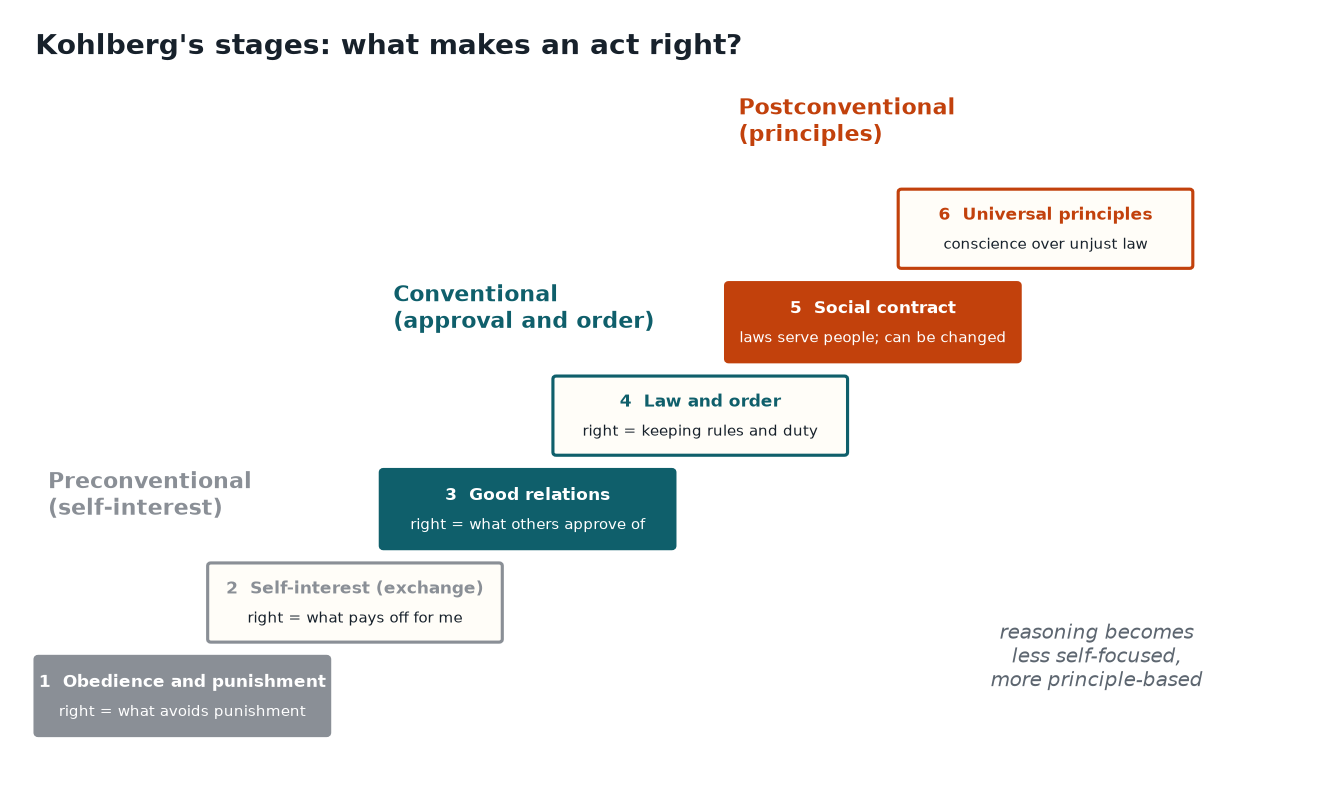
The three levels and six stages
| Level | Stage | What makes an act right | Typical phrase |
|---|---|---|---|
| Preconventional | 1. Obedience and punishment | Avoiding punishment from authority | "You will get in trouble" |
| Preconventional | 2. Self-interest (instrumental exchange) | Getting rewards, fair trades | "What do I get out of it?" |
| Conventional | 3. Good interpersonal relations | Being seen as a good person, approval | "A good friend would" |
| Conventional | 4. Law and order (social order) | Duty, rules and keeping society running | "If everyone did that, there would be chaos" |
| Postconventional | 5. Social contract | Laws are agreements that serve people and can be changed | "The rule exists to protect rights" |
| Postconventional | 6. Universal ethical principles | Self-chosen principles such as justice and dignity | "Conscience outranks an unjust law" |
Preconventional level
Moral rules are external and tied to consequences for the self. In stage 1, an act is bad because it is punished. In stage 2, right means what serves one's own needs, with fairness understood as an even trade: "I helped you, so you help me." This level is typical of young children, though older people can reason this way too.
Conventional level
The person has taken society's expectations inside. Stage 3 reasoning centers on loyalty, trust and approval from family and friends. Stage 4 widens the view to the whole social system: laws must be obeyed because they hold society together, and duty matters even when no one is watching. Kohlberg found that most adolescents and adults reason at this level.
Postconventional level
Rules are judged against deeper principles. In stage 5, laws are seen as social contracts that protect rights and welfare, so an unjust law should be changed through fair procedures. In stage 6, the person follows universal principles of justice and human dignity even when they conflict with law. Only a minority of adults reason at this level, and stage 6 was so rarely found that Kohlberg later stopped scoring it in his research.
Worked example: scoring three answers
Dilemma: Maya works night shifts at a warehouse. She sees a coworker take home boxes of baby formula that were about to be thrown out because their labels were misprinted. Company policy says all damaged stock must be destroyed. Should Maya report him?
Three students answer:
- "She should report him, because the boss said to, and if the boss finds out she stayed quiet she will be punished." - The rule matters only because an authority will punish disobedience. Stage 1.
- "She should not report him. He covers her breaks, and if she keeps quiet he will owe her one." - Right is a fair trade that benefits her. Stage 2.
- "She should report him. Policies only work if workers follow them, and if everyone ignored the ones they disliked, the company could not run." - Duty and the need to keep the system working. Stage 4.
Now a fourth answer: "The rule is meant to protect customers from bad products, not to waste good food. She should push for the policy to allow donation, but taking it secretly undercuts that process." The student judges the rule by its purpose and favors changing it through fair procedures, which is stage 5.
Notice that answers 1 and 3 reach the same decision, report him, from stages three steps apart. That is the point Kohlberg's method is built on.
Critiques you should know
- Gender bias (Carol Gilligan). Gilligan argued that Kohlberg's scale, built from a male sample, rates a justice orientation (rights, rules, fairness) above a care orientation (relationships, responsibility, avoiding harm). Reasoning centered on care could be scored at stage 3, making it look less mature.
- Cultural bias. The higher stages reflect individual rights, which fit Western, individualist societies. Reasoning that centers on community or harmony may be underrated.
- Reasoning versus behavior. The theory measures how people talk about dilemmas. High-stage reasoning does not guarantee moral action.
- Stage 6 is rare. So few people showed it that its status as a regular stage is doubtful.
Common traps
- Judging the choice instead of the reason. Stealing or not stealing tells you nothing by itself.
- Mixing up stages 3 and 4. Stage 3 is about specific people and approval. Stage 4 is about the whole system, laws and duty.
- Mixing up stages 4 and 5. Stage 4 says obey the law because it is the law. Stage 5 says the law serves a purpose and can be changed when it fails.
- Confusing Kohlberg with Erikson or Piaget. Kohlberg is moral reasoning; Erikson's stages are psychosocial crises across the lifespan and Piaget's stages are cognitive development.
- Assuming everyone reaches the top. Most adults stay at the conventional level.
The 8A pack adds flashcards and practice questions on Kohlberg, Erikson, Freud, Vygotsky and identity formation: see the 8A pack, or try the free sampler first.
One-minute recap
- Three levels, two stages each: preconventional (punishment, self-interest), conventional (approval, law and order), postconventional (social contract, universal principles).
- The stage is set by the reasoning, not the decision.
- Most adults reason at the conventional level; stage 6 is rare.
- Gilligan's critique: a male sample and a justice focus undervalue an ethic of care.
- Other critiques: cultural bias and a gap between reasoning and behavior.
Check yourself: 5-question mini-quiz
1. A child says lying is wrong "because Mom will take away my phone." Which stage is this?
Stage 1, obedience and punishment, since the act is wrong because of the punishment it brings.
2. A voter argues a law should be repealed because it no longer protects the rights it was written to protect. Which stage?
Stage 5, social contract, because laws are treated as changeable agreements that serve people.
3. What separates stage 3 from stage 4 reasoning?
Stage 3 seeks approval from specific people and being seen as good; stage 4 focuses on duty, laws and keeping the whole social system working.
4. What was Carol Gilligan's main criticism of Kohlberg?
That a scale built on a male sample favors a justice orientation and underrates a care orientation centered on relationships and responsibility.
5. At which level does Kohlberg place most adults?
The conventional level, stages 3 and 4; postconventional reasoning is reached by only a minority.
Free MCAT sampler
Free sample: a 3-page MCAT cheat sheet (PDF), plus 6 short high-yield lessons by email
Enter your email and download a real page set from a paid pack: the 3-page Amino Acids, Proteins and Enzymes cheat sheet (PDF). Confirm your email and short MCAT lessons follow. Free, no card.
Prefer not to sign up? The sampler is open to everyone: free notes, practice sets and the study schedule generator.
Check your email
We sent a link to confirm your address. Nothing else is sent until you click it.
Download your free sample: 3-page Amino Acids, Proteins and Enzymes cheat sheet (PDF)
Meanwhile, start with the free notes.
Keep studying
- Erikson's 8 Stages of Psychosocial Development Explained
- Piaget's Stages of Cognitive Development for the MCAT
- Weber Fraction Formula and JND: Worked Examples
- Stress Response: General Adaptation Syndrome, Cortisol and Appraisal
- Self-Serving Bias vs Actor-Observer Bias: The Difference
- Schachter-Singer Two-Factor Theory vs Cannon-Bard: How to Tell Them Apart
- Causes of Death in Each Stage of the Demographic Transition (Epidemiologic Transition)
- All free notes
Check your email
We sent a link to confirm your address. Nothing else is sent until you click it.
Download your free sample: 3-page Amino Acids, Proteins and Enzymes cheat sheet (PDF)
Meanwhile, start with the free notes.